Join us Dec. 1-3 in Nashville for the Digiday Programmatic Marketing Summit
Viral publishers see sharp engagement drops on Facebook

LittleThings shut down after Facebook’s algorithm change cut its organic reach by 75 percent, but it’s not the only social publisher that’s in danger, data from several analytics firms suggests.
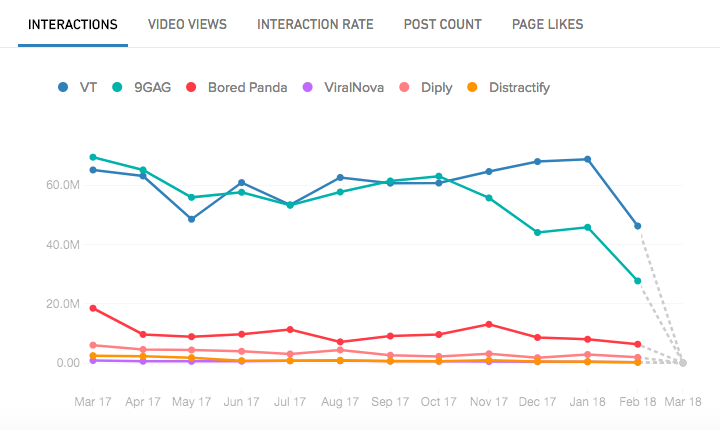
Publishers such as Viral Thread, ViralNova, 9gag, Bored Panda, Diply and Distractify have all seen interactions — likes, shares, comments and other reactions — slide precipitously since Facebook announced in January that it would deprioritize publisher content in its news feed, according to Facebook-owned CrowdTangle.
That drop implies Facebook has limited their reach on its platform, bad news for publishers that depend heavily on Facebook for referral traffic, according to data from internet analytics firm Jumpshot. Distractify, for example, saw its monthly traffic decline 78 percent year over year in January and 84 percent year over year in February, with most of the declines attributable to declines in Facebook referral traffic.
Some of these sites are more dependent on Facebook than others — just 12 percent of 9gag’s desktop traffic comes from Facebook, compared to 85 percent for Viral Thread, according to SimilarWeb data. But regardless of how dependent they are, it seems that Facebook sees less value in showing that kind of content to its user base.
“Publishers who had a heavy reliance on gaming Facebook news feed algorithms circa 2016-2017 will be hurting bad right now,” said Matt Navarra, director of social media at The Next Web. “Those publishers who failed to diversify their social platform distribution model or went all-in on Facebook will be regretting it in 2018.”
The declines are just part of a slide that publishers have been riding for over a year. While Facebook prioritized native video and Instant Articles, publisher referral traffic from Facebook declined substantially. In late 2017, Google surpassed Facebook as the top source of publisher referral traffic, leading some search-focused publishers to gloat.
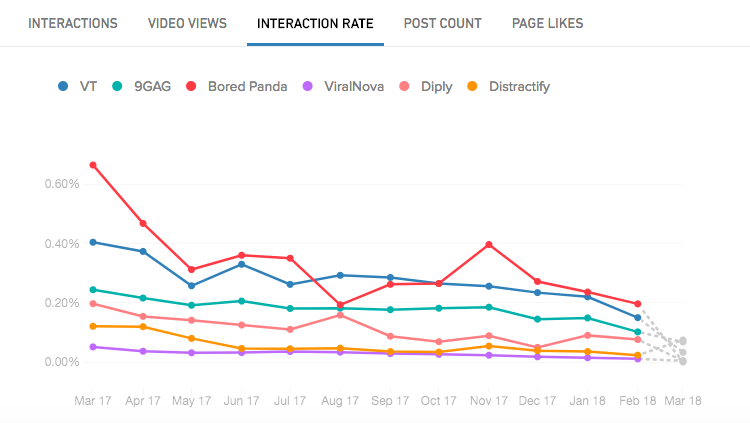
But the severity of these drops varies. The interaction rate on 9gag’s posts fell 50 percent month over month from January to February, according to CrowdTangle data; Viral Thread’s interaction rate fell 32 percent, the second-largest decline month over month, over the past 12 months, according to CrowdTangle data. Neither publisher responded to a request for comment.
In the days following Facebook’s announcement that its users would see 20 percent fewer posts from publishers’ pages in their news feeds, publishers speculated about who would be affected most.
Nearly two months later, the effects are hitting some publishers harder than others. LittleThings was forced to shut its doors, while other publishers have had mild to negligible changes to their referral traffic.
“It’s no surprise the impact on some publishers is minor, whilst for others, it’s utterly devastating,” Navarra said. “We shouldn’t forget Facebook’s push on ‘meaningful engagement.’ Some publishers will be struggling to generate it if their mix of content is not adaptable enough to bend to [Mark Zuckerberg’s] latest desire to drive ‘meaningful interactions.’”


More in Media

The Verge switches up its audience team to prepare for Google Zero
The Verge has restructured its audience development team to prioritize loyal readers over traffic and page views.

Reach CEO touts Google AI deal as a template, steps up pressure on OpenAI over scraping
Digiday spoke with Reach CEO Piers North about his plans to make its Google AI content deal a blueprint framework for other LLM deals, and its recent cease-and-desist letter to OpenAI.

Social commerce edges past SEO at The Independent for the first time
The Independent’s social-commerce revenue edged past its SEO-based commerce revenue for the first time in September, CEO Christian Broughton said at Digiday’s Media Strategies event in London this week.