Join us Dec. 1-3 in Nashville for the Digiday Programmatic Marketing Summit
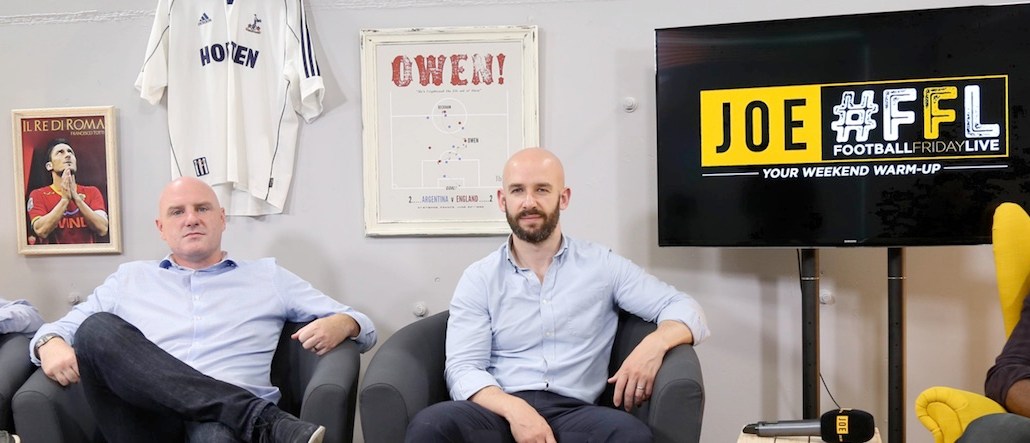
Publishers like Joe Media are evolving their Facebook Live strategies beyond the lo-fi experimentation with blowing up fruit to something more polished and TV-like.
For the last three weeks, young-men publisher Joe Media has streamed on Facebook “Football Friday Live,” a 30-minute weekly panel discussion about the Premier League. It features former Tottenham Hotspur footballer Ledley King and Joe journalists Tony Barrett, Dion Fanning and Jim Daly. The first “Football Friday Live” Facebook Live episode has now got nearly 400,000 views, the second is nearing on 200,000. It will run up to 38 episodes.
“Football Friday Live” is much like your typical football gabfest show on TV, albeit with a more relaxed feel. The pundits are arranged on a couch and comfy chair, with a multiple-camera shoot at Joe’s studio in London. Mostly, they discuss the week’s events, everything from the games played to the players’ personal lives. Intercut with the discussion are pre-recorded segments where presenter Daly chats to fans, or play football with King.
“The main takeaway is that people get excited about live viewers,” said Joe Media CEO Will Hayward. “Others might optimize to massive viewership figures. We’re sticking to the principle of high-quality experience that people enjoy. There’s a gap in the market for quality experiences on Facebook.”
Joe Media is planning a raft of TV-like shows to live stream around lifestyle topics like fitness. The company has a 15-person video team, split between London and Ireland, which it plans to grow to 55 in the next year. The advent of live streaming on Facebook and other platforms is giving digitally native publications like Joe an opportunity to inch into programming that looks and feels a lot like TV, albeit frequently with lower production values. While Facebook looms large for distribution, other platforms are rushing into live programming.
This week Joe’s taking “Football Friday Live” to Periscope, Twitter’s live-streaming app. Twitter is pushing media companies to encourage them to use its own products for live streaming. Sky News, for example, was the first European media company partnering with Periscope to pull live streams of its political news onto Twitter too.
“Twitter is still the place that people go for real-time conversation,” said Hayward. “The nature of “FFL” is very much a live experience. Facebook gives you reach, but Twitter gives you influence.” Twitter will give Joe an assist by tweeting out the live stream from its own Twitter Sports account, which has 14 million followers. Joe Media’s sports account has just 300,000.
Viewership figures and a more polished feel are, of course, key for advertisers. Joe offers sponsorships on its live channels: Marketers can have their brands featured prominently on the show — logo placement in the opening titles, for example — but don’t have editorial control. From January, the show will have a sponsor brand for 12 months. It’s a more consistent revenue stream than creating branded content campaigns month by month, said Hayward.
By the end of this year, it plans to have 80 percent of its revenue coming from sponsored content. Currently, very little of its revenue comes from sponsored content, although Hayward declined to discuss specific figures.


More in Media

Why CNN International is building for agentic ad market that barely exists yet
CNN International is still chasing its first agent-sold dollar by Q1.
Media Briefing: The transatlantic push to rein in stealth bots is gathering pace
U.S. and U.K. publishers are pushing for laws to crack down on stealth AI crawlers as bot scraping surges and demands for transparency grow.

Creator mentors Colin and Samir want to turn their followers’ ideas into productions
Creator mentors Colin and Samir teamed up with Adobe to fund a creator’s project; the first step towards the duo’s new production era.