Join us Dec. 1-3 in Nashville for the Digiday Programmatic Marketing Summit
Despite what many ad networks may claim, targeting capabilities for the mobile channel remain relatively rudimentary. Without a cookie, the promise of mobile targeting remains mostly just that: a promise.
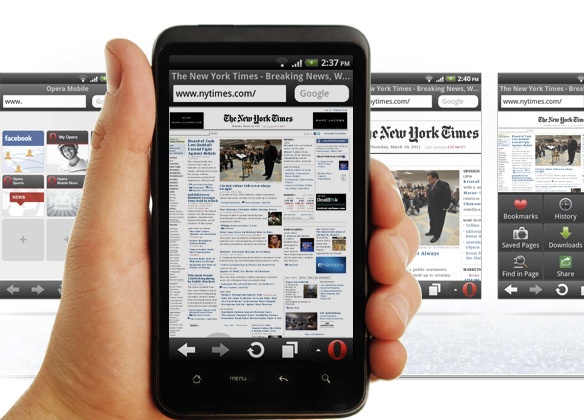
But browser manufacturer Opera has a trick up its sleeve, in the form of behavioral data collected from its mobile browser products Opera Mini and Opera Mobile. It’s moving to mine that information with a series of acquisitions, including the additions this week of ad network Mobile Theory and U.K.-based network and agency 4th Screen Advertising. It already owns mobile yield optimizer AdMarvel, which it bought in 2010.
Opera already owns an ad exchange, with which it can target buys based on the data it gleans form users’ browsing habits. Browser behavior, if parsed correctly, offers a wealth of data.
“It’s unique to our product because of our cloud-based browsing system,” said Mahi de Silva, the firm’s evp of consumer mobile. “We do this to accelerate the browsing experience for users, but it also gives us key insights.”
Opera Mini and Opera Mobile, which run on smartphones such as iPhone and Android devices, request Web pages from Opera’s servers, which compress them before sending them to a user’s handset in order to speed up their experience. Meanwhile, the company logs that data and segments users based on the sites they visit.
“If I happen to be a big Manchester United fan and I visit their site frequently, I would index high in the sports category, and an advertiser can target using that information,” de Silva said.
That type of targeting is nothing new in the desktop world; ad networks have been doing it for years. But the lack of cookies makes it extremely difficult to achieve in mobile. Some networks and vendors are gravitating towards fingerprinting as a way to tie behaviors to devices, but Opera has access that data at the source – the browser.
The technique opens the way for the dominant players in mobile, Apple and Google, to follow suit. Apple’s phones come pre-loaded with its Safari as the default browser; Google Chrome is starting to infiltrate mobile devices.
De Silva emphasized that the company does not track personally identifiable information, sell data to third parties or even give agencies and advertisers access to it. But its opt-out policy is still in the works, he suggested. “Today opt-out mechanisms are still being worked out in the standards realm,” he said. “But we’re very clear in our privacy policy that we gather this data and use it to monetize.”
Publishers get a look-in, too. Those that register with its publisher network are given insights into the types of users that visit their properties. According to de Silva, the company wants to expand the entire mobile ecosystem rather than just catering to the buy-side.
“It’s all about sharing intelligence among the community, unlike a Google that amasses that information to better their own business. We think that approach will drive traction,” he said.


More in Media

The Hill adds interactive election tools to subscription offering ahead of the midterms
The Hill is betting on interactive subscriber-only features to help grow its new subscription business ahead of the 2026 midterms.

The Daily Mail tests GEO with brands ahead of AI visibility product
The Daily Mail is running around a dozen GEO tests to work out what works before turning its AI visibility offering into an official product early next year.

Meta delays rollout of updated commercial terms amid publishers’ collective pushback
Meta’s updated commercial terms have galvanized publishers into a coordinated pushback over the company’s use of their content.