Join us Dec. 1-3 in Nashville for the Digiday Programmatic Marketing Summit
Precious few people have seen an Apple Watch in person, but publishers are betting Apple will churn out another hit with consumers.
“It’s a gamble, but it’s one we decided to make,” said Andrew Phelps, senior product manager at The New York Times, one of the handful of publishers featured Apple’s watch event in March.
And the Times isn’t alone. Despite the fact that few people outside the media — and few publishers themselves — have actually used an Apple Watch yet, publishers are still putting time and energy into developing for it. Here are a few ways they’re approaching the puzzle.
The New York Times: Apple Watch-specific content
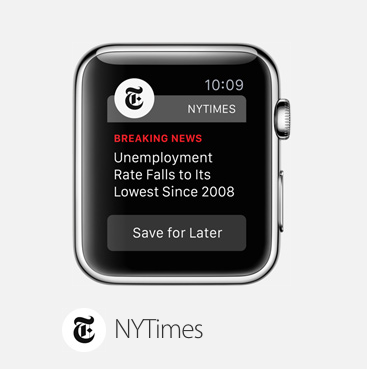 The Gray Lady is giving into a lot of the more obvious Apple Watch use cases — but it’s also going beyond them. While the app will feature breaking-news alerts and let users click over to full news stories on their iPhones via Apple Handoff, it will also feature one-sentence stories written exclusively for the Apple Watch app. The Times hopes that these short stories will make it easier for users to get caught up on updates.
“We didn’t want to just put headlines on the watch or just take the top stories from the app and shrink them down to a small screen,” said Phelps. He said that the goal is to design the Apple Watch app to both push information and make it easier for users to pull information when they need to.
Developing for the Apple Watch has also changed how the Times approached development as a whole. Rather than think “desktop down,” Phelps said, The Times is thinking “watch up.”
“If nothing else, this project has forced us to make good, hard design and newsroom decisions about mobile production, so we’re still getting a lot out the process of building for it,” he said. “We’ve gotten a lot out of the process, even if not one Apple Watch is sold.”
CNN: Push alerts and personalization
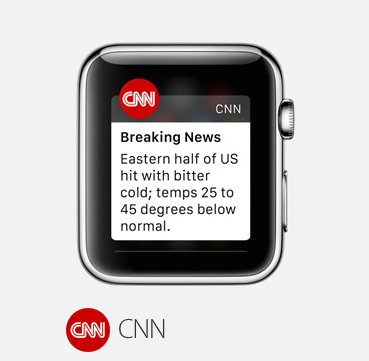 Watches are deeply personal devices, as Apple pointed out many times in its March presentation. CNN took the message to heart. Its Apple Watch product has been built around creating a “personal” experience for users, who can opt-in to breaking-news alerts across 12 categories, including Top Stories, Politics Tech, Health and Entertainment. Personalization is also a part of its larger strategy, which it hopes will create stickiness with users across platforms.
“If we want to be the world’s alert platform and the news agency that keeps you connected, it’s going to be important for us to make a big play in wearables because they’re personal,” said CNN chief product officer Alex Wellen.
But personalization serves a deeper role with wearables, which come with a much lower tolerance for unhelpful push notifications. Because of this, developers have to be more careful that the recommendations they’re pushing are relevant to readers. That’s a significant technical challenge, but one that could be a big differentiator for the publishers that pull it off.
“We’re trying to find the perfect combination of technology and editorial to deliver something truly unique,” Wellen said.
The Economist: Less text, more audio
While most publishers are leaning toward text and push notifications, The Economist is betting on audio. Its own Apple Watch app will let users control playback of The Economist’s audio edition as it plays on their iPhones (the audio doesn’t play directly on the Watch). It’s a small feature, but The Economist says there’s a major advantage to being there on day one.
“We don’t think that reading the kind of articles that we write on a screen of a device that small makes much sense, but we do think that it’s a very natural interface for controlling audio,” said Economist deputy editor Tom Standage. “It’s a remote-control mechanism.” He said the hope is that by making it easier to listen to the Economist’s audio edition will deepen reader engagement and encourage them to hold onto their subscriptions.
The Economist’s Apple Watch app, which took two developers a week to put together, is unlikely to extend to features news alerts. Standage said that while that approach makes sense for publishers that churn out a lot of news, it makes less sense for The Economist, which specializes in analysis and opinion. But Standage said that The Economist’s approach to the Apple Watch could change over time as it learns more about how people use the device.
“Honestly, no one knows how things are going to look,” Standage said. “The only way you’re going to find out is once this gets into the hands of users and see what their usage patterns are.”


More in Media
The Hill adds interactive election tools to subscription offering ahead of the midterms
The Hill is betting on interactive subscriber-only features to help grow its new subscription business ahead of the 2026 midterms.
The Daily Mail tests GEO with brands ahead of AI visibility product
The Daily Mail is running around a dozen GEO tests to work out what works before turning its AI visibility offering into an official product early next year.
Meta delays rollout of updated commercial terms amid publishers’ collective pushback
Meta’s updated commercial terms have galvanized publishers into a coordinated pushback over the company’s use of their content.