Ad Tech Briefing: Criteo named first ad tech partner to OpenAI’s ChatGPT ad pilot

This Ad Tech Briefing covers the latest in ad tech and platforms for Digiday+ members and is distributed over email every Tuesday at 10 a.m. ET. More from the series →

Earlier this week, Criteo confirmed it is the first ad tech partner to integrate with OpenAI’s advertising pilot in the U.S., available in ChatGPT’s free and Go tiers. The move formalizes what the company first hinted at in late 2025 — that large language models would become the next frontier of its commerce media strategy.
The announcement positions Criteo’s demand platform as the connective layer between brands and OpenAI’s early-stage ad environment. In practical terms, marketers using ChatGPT will be able to tap Criteo’s commerce data and activation tools as part of OpenAI’s experimental monetization framework, extending Criteo’s reach beyond retailer sites and the open web into conversational interfaces.
The partnership builds on Criteo’s broader thesis, i.e., that LLMs will require structured, transaction-linked commerce signals to support monetizable discovery as generic web-crawl data is insufficient for high-quality product recommendations.
In late 2025, Criteo teased some of its early experiments with LLM — at that point, the partnership between the pair hadn’t been confirmed publicly — which involved piping signals such as product relevance, trendiness, and retailer-level performance into LLM environments via its Model Context Protocol server, effectively allowing AI agents to query Criteo’s APIs when generating recommendations.
“The capability in the engine drives the full funnel… our deep learning capability can make sense of scattered interactions to uncover product recommendation opportunities,” said CEO Michael Komasinski speaking at the time, underscoring the company’s argument that its two decades of recommendation modeling give it an edge in a commerce ecosystem mediated by AI.
Internally, Criteo has been embedding AI into campaign setup and optimization workflows, with tools such as its “audience agent” allowing marketers to describe objectives in plain language. Through MCP integrations, those workflows can now be executed from within LLM interfaces, rather than solely inside Criteo’s native UI.
Chief product officer Todd Parsons has also framed the shift as an evolution of the company’s earlier shift towards commerce media, a conversation that proved crucial in the early part of the 2020s, as traditional static identifiers, crucial to Criteo’s retargeting roots, were challenged. “In the past, you would have to look up our taxonomy, and you would have had to select or deselect a load of audience attributes,” he earlier explained, arguing that AI now collapses those manual planning steps.
Commercially, the contours remain fluid. Criteo executives have referenced models ranging from data licensing and pay-per-query structures to native ad formats within LLMs. But strategically, the direction is clear: if conversational AI becomes a primary “shop window,” Criteo intends to supply the recommendation infrastructure behind it.
For a company long associated with retargeting — and more recently with retail media and post-cookie reinvention — the OpenAI pilot offers validation of its attempt to reposition itself as the commerce intelligence layer for an agentic era.
As detailed in Digiday’s earlier coverage of its LLM experiments, the bet is not that AI displaces ad tech, but that it reshapes where ad tech operates — shifting the front end to AI while vendors like Criteo power relevance behind the scenes.
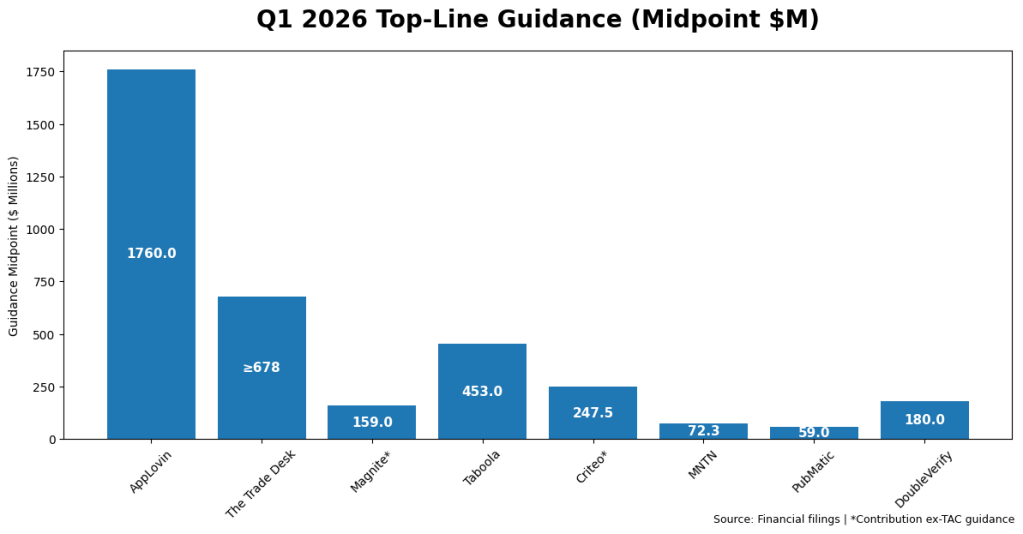
The development is likely to assuage investor concerns, which may have been raised after the company earlier reported a 2% dip in its Q4b revenues ($541 million), with its top-line guidance for Q1 revenue – excluding traffic acquisition costs this was estimated to be in the range of $245 million to $250 million – considered to be relatively soft by the markets.
What we’ve heard
“Whoever owns measurement owns the space. Google already owns the defacto [sic] measurement of DR with Google Analytics… This is the fight for independent media.”
—TAU Marketing Solutions’ chief Robert Webster raises the issue of YouTube-parent Google sending a cease-and-desist order to U.K. independent TV-ratings outfit BARB and its partner Kantar Media*, alleging a violation of its terms of service.
Numbers to know
What we’ve covered
‘Agentic with a small a’: CMOs are adopting AI more slowly than it’s evolving
Something counterintuitive is happening in advertising: AI is moving fast. Marketers are not.
Evidence filed in a recent whistleblower case between WPP and a former executive at the agency holding company contains internal data on client opt-in rates, platform spend, and income targets that haven’t been public until now.
What we’re reading
Google brings Marketing Mix Modeling to the masses
Google has launched a new code-free interface that helps non-technical users explore Meridian data to understand ad campaign performance better. They can also use the tool to stress test various scenarios for campaign planning and optimization.
Koah raises $20.5M to build AdSense for AI
The San Francisco-based company, which embeds sponsored ads directly into AI chatbots, has raised $20.5 million in a Series A round led by Theory Ventures.
Hiring news out of OpenAI
And it centers all around their ads business. Per the listings, it will offer to pays Ads Integrity Software engineers will be between $230K to $385K and offers equity.
Advertising grew 8.9% in 2025, but three companies took most of the spoils
The triopoly sails on.
*Editor’s note: An earlier version of this article incorrectly stated that BARB’s partner was Kantar Research; it has been amended to correct this.


More in Media Buying

D+ Research: Marketers embrace AI for social and retail media, but show skepticism in AI ad buying
For all the chatter about AI’s impact on marketing workflows and outputs, most marketers have yet to embrace the technology for social media and retail media, according to a Digiday+ Research survey.

Mile Marker acquires Lift to enhance its creative and digital performance chops
The PE-owned independent continues to acquire shops that round its offerings, the latest adding creative and performance assets as the two explore how to apply AI.

How automation and AI is reshaping the traditional upfront marketplace
As programmatic automation and AI agents reshape the traditional upfront marketplace, media buyers are navigating a new balance.