Join us Dec. 1-3 in Nashville for the Digiday Programmatic Marketing Summit
Travel app Skyscanner’s social customer service response goes viral on Facebook

Most brands respond to customer service complaints online with canned tweets and Facebook messages. But a little creativity can help you strike viral marketing gold, as travel app Skyscanner discovered when its humorous response to a customer query went viral on Facebook, getting over 17,000 likes and over 2,700 shares.
It all began last week, when a user named James Lloyd got a suggested itinerary from the app saying he would have a layover in Bangkok lasting 413,786 hours, or 47.2 years.
The amused Lloyd shared a screenshot of the itinerary on the brand’s Facebook page on Aug. 23, with the caption, “Hi Skyscanner. Just wondering what you’d recommend I do during the 47 year layover your website has suggested?”
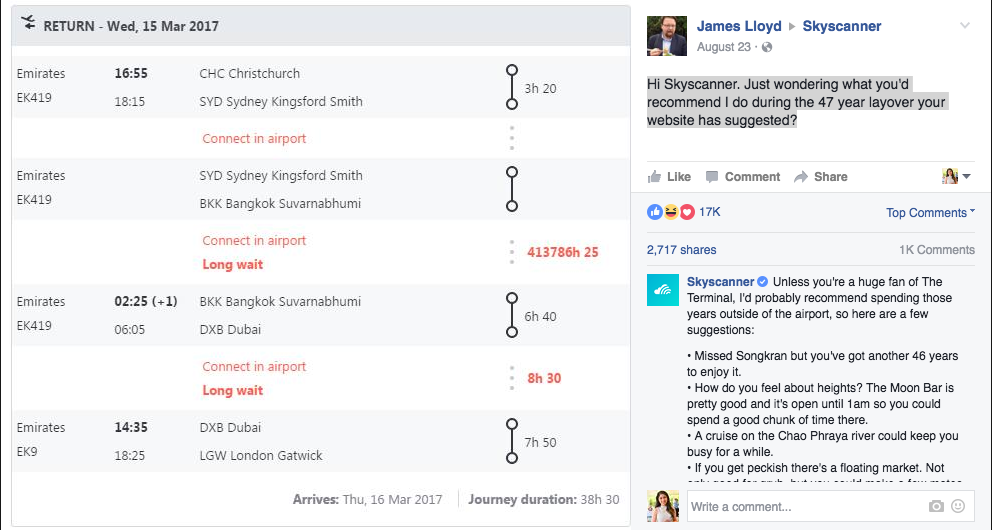
A rep named “Jen” responded to his post three days later with a detailed itinerary of Bangkok, rather than a run-of-the-mill reply directing him to a call center.
“Unless you’re a huge fan of The Terminal, I’d probably recommend spending those years outside of the airport, so here are a few suggestions,” she said, before recommending that he go check out a rooftop bar, take a cruise, check out the floating market and even become a Tai chi expert.

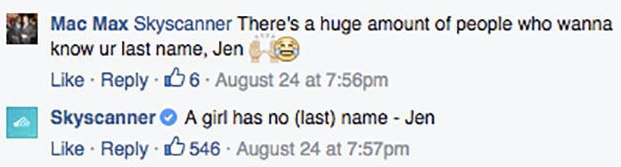
Jen from Skyscanner didn’t stop there. She went through the comments, initiating several other conversations — even throwing in a Game of Thrones reference when someone asked for her full name.
Such unscripted responses by brands’ social media agents is a growing trend, said Paul Johns, CMO at social customer service company Conversocial.
“Customers increasingly appreciate it, because they’ve gotten bored of the sterile nature of branded customer service,” Johns said.


More in Marketing

Future of Marketing Briefing: Creators had a big year. Christmas still went to the celebrities
Despite leaning on creators for most of the year, marketers aren’t doing it for the holiday crunch. That job still belongs to celebrities.

In graphic detail: Six thousand brands later, ChatGPT ads still have a conversion problem
OpenAI has ambitious ad revenue targets, which depend on advertiser demand, measurement and monetisation.

Agencies find AI overuse is leading to brief bloat
Agencies and marketers now frequently use AI tools to create media and creative briefs. But the practice could be a canary in the coalmine for AI overuse in advertising.