In graphic detail: How Anthropic’s Pentagon refusal is paying off in downloads, brand trust and enterprise deals

Anthropic’s war with Washington last week is winning in the public.
The $200 million it walked away from by refusing the Pentagon’s demands may turn out to be the best marketing spend in Silicon Valley for years. Its principled stand has driven a surge in users and supercharged its brand — no small feat for a company that has always bet on enterprise over the masses. What makes this all the more remarkable is that it happened in the same week Anthropic quietly loosened its own safety commitments, dropping a hard pledge to pause training more powerful models if it couldn’t guarantee were safe. The public, it seems, is responding to the fight it can see — not the fine print it can’t.
And in doing so a moral line is being drawn — real or perceived — between Anthropic and its rivals. OpenAI, which stepped in to take the Pentagon contract Anthropic refused, now finds itself on the wrong side of it.
The data tells the rest of the story.
Anthropic’s Claude builds momentum while OpenAI’s ChatGPT plateaus
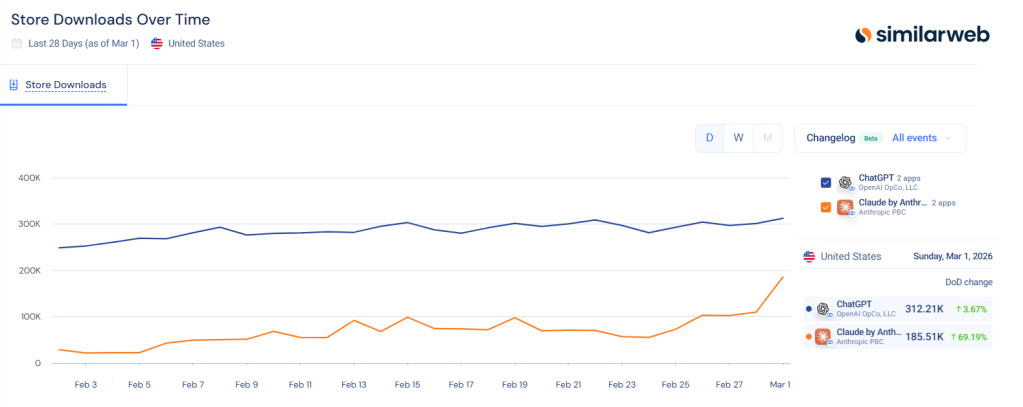
For the most part, OpenAI’s ChatGPT is growing from a much larger base, already around 900 million users, compared to Anthropic’s Claude’s 10 million daily active users, per Similarweb’s estimates. However, right after the Pentagon deal was announced on Feb. 28, downloads for Claude in the U.S. spiked.
As of March 1, the day after OpenAI’s Pentagon deal was announced, while ChatGPT saw 312,210 downloads, a modest increase of 3.67% compared to the previous day, Claude experienced 185,510 downloads on the same day, increasing 69.19% on the previous day, per Similarweb.
This sharp contrast suggests that users often signal their preferences through action — and in this case, many appear to have shifted toward Claude.
Anthropic’s Claude climbs the category rankings
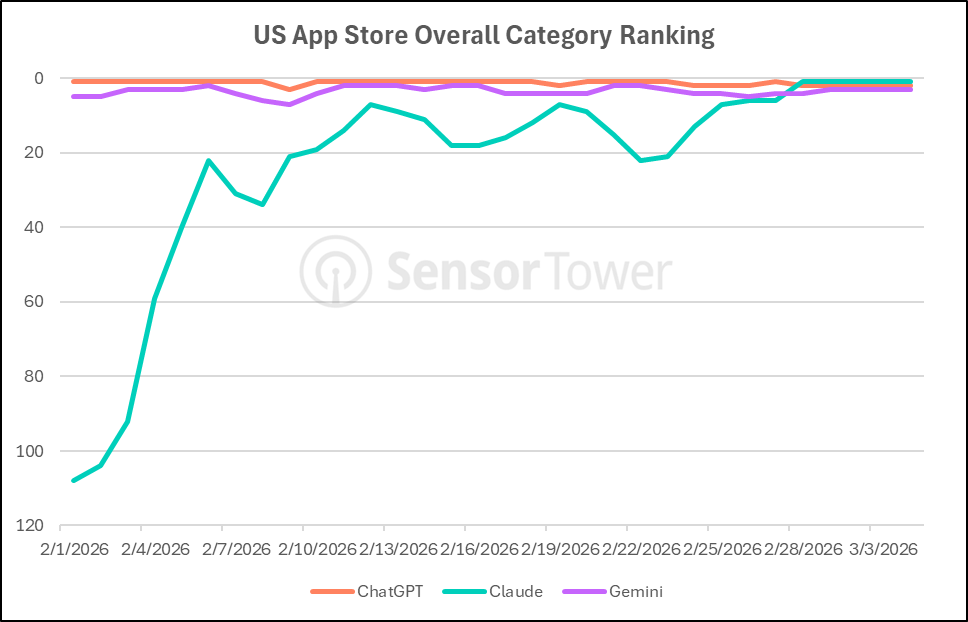
And those downloads have allowed Claude to come out on top when it comes to popularity. According to data from Sensor Tower, Claude was just outside the top 100 at the end of January, reaching 131 on Apple’s U.S. top free apps chart on Jan. 30 — and has spent most of February somewhere in the top 20.
Then the Pentagon standoff pushed it even further. During the weekend (Feb. 28 – March 1) following the government clash, the Claude iOS app climbed to the number one spot on Apple’s U.S. top free apps chart, pushing ChatGPT down to number two and Google’s Gemini to fourth place.
Additional data from Sensor Tower found that after the deal was signed, U.S. app uninstalls for ChatGPT increased by 295% — further emphasizing that users were unhappy with the announcement.
Anthropic is winning when it comes to brand positivity
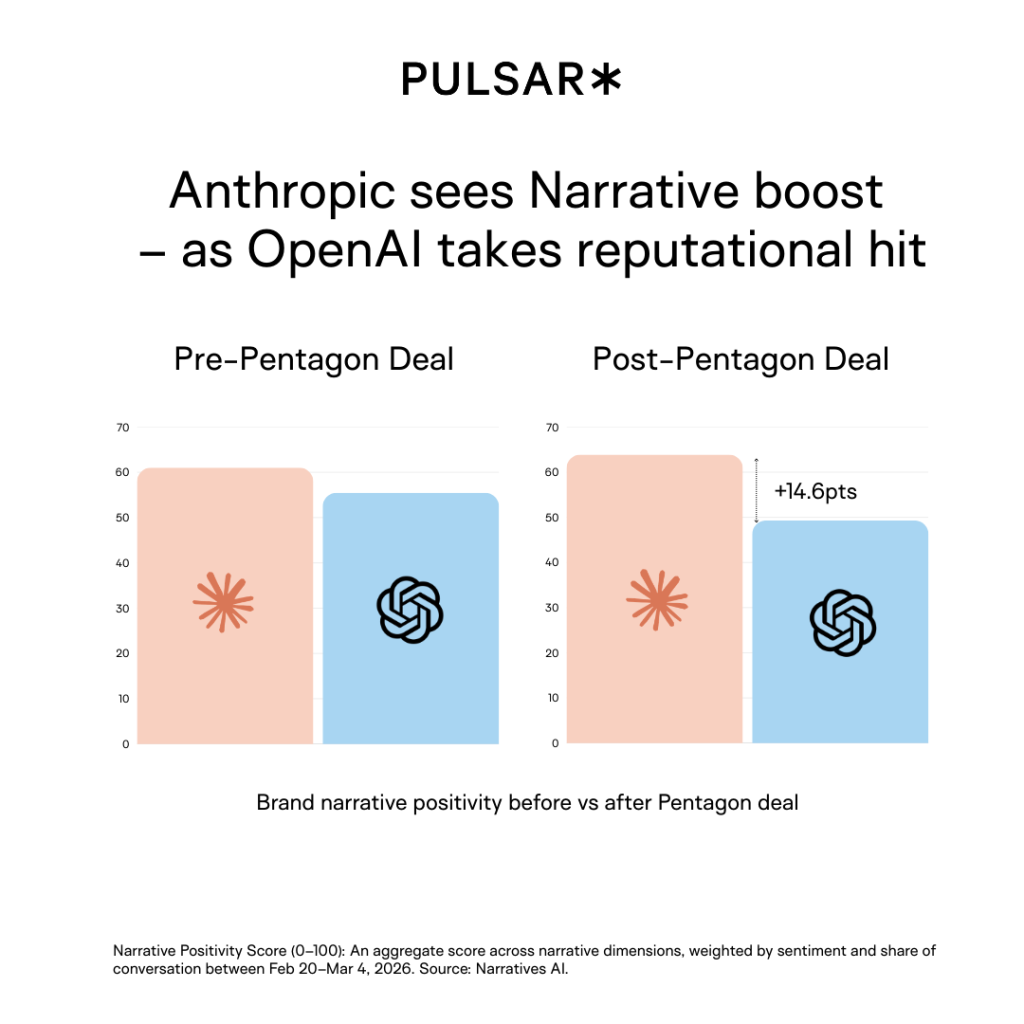
The Pentagon deal seemed to have a significant impact on brand perception. Before the contract was signed, Anthropic was slightly ahead when it comes to positivity around the brand’s narrative. According to Pulsar, which tracked sentiment and share of conversation between Feb. 20 and March 4, before the deal, Anthropic had a positive narrative score of 61.2 out of 100, while OpenAI’s score was 55.5 — a 4 percentage point difference.
After Anthropic’s refusal, and OpenAI signed the deal, Anthropic gained more momentum. It steamed 14.6 percentage points ahead to 63.9 out of 100, while OpenAI trailed 14.6 percentage points behind at 49.3, per Pulsar, as users boycotted OpenAI and openly showed their support toward Anthropic.
Businesses across the board are more open to Anthropic
While OpenAI has an established enterprise business, some companies are instead turning to Anthropic.
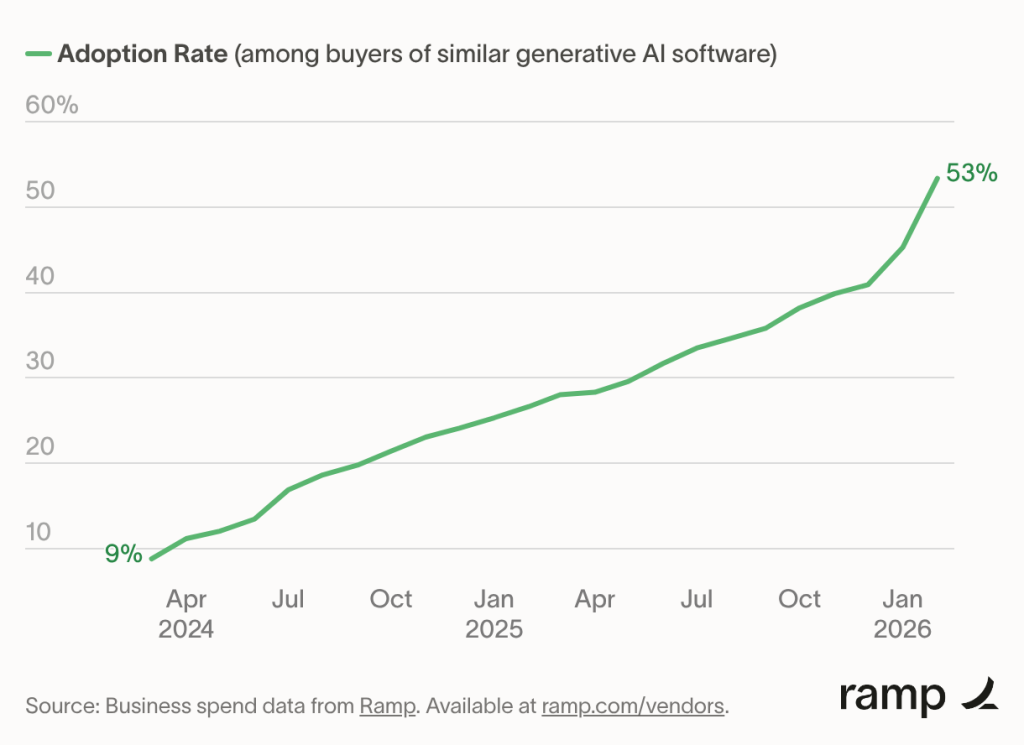
Ramp’s procurement data (drawn from real-world business transactions) shows that as of March 2026, 56% of organizations using a generative AI vendor use Anthropic — up from 29% a year ago. OpenAI, by contrast, currently has an overall business adoption rate of 84%, though that figure has slipped 2% since 2025.
Breaking adoption down by company size shows OpenAI remains strongest among large enterprises, where its adoption rate reaches 91%, falling to around 79% among micro-SMBs. Anthropic, however, sees its adoption spread more evenly across businesses of all sizes, with adoption rates ranging from 54% to 57%, per Ramp.
Even though Anthropic hasn’t overtaken OpenAI just yet, it appears to be expanding faster, and across more of the market.
OpenAI’s ChatGPT’s dominant grip is loosening
While ChatGPT remains the dominant app, at least for now, the gap for challengers like Anthropic is closing.
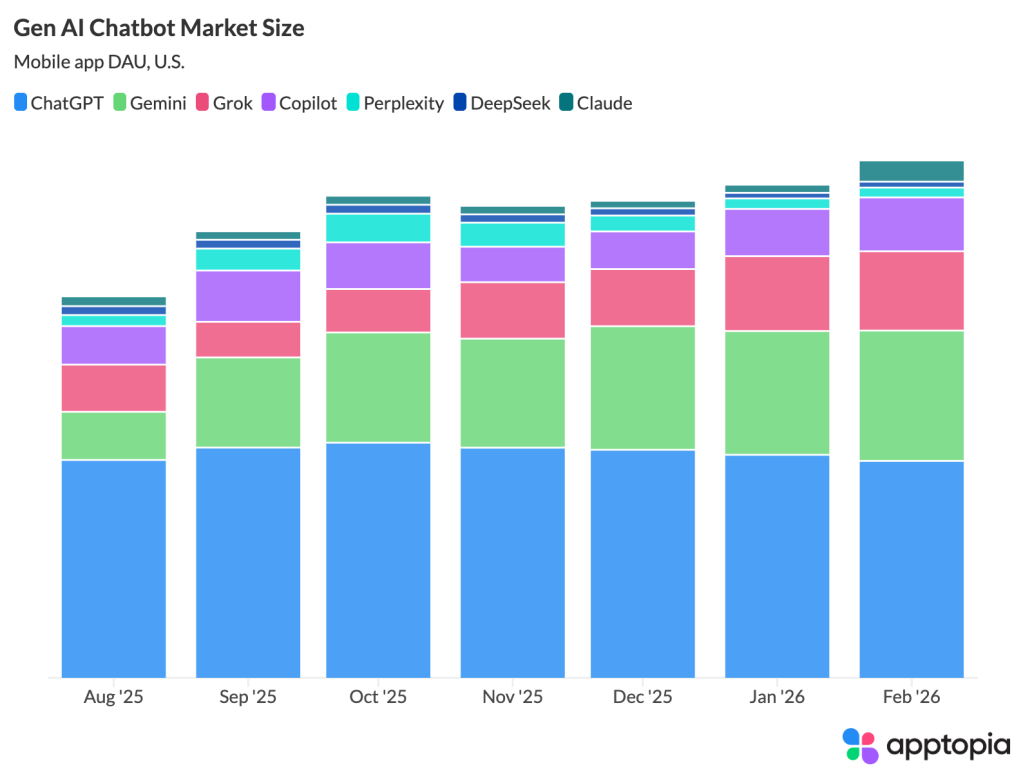
ChatGPT’s mobile app market share among the top seven AI chatbot apps fell from 57% to 42% in the U.S. and from 73% to 57% globally, according to Apptopia, which tracked changes between August 2025 and February 2026.
During the same time period, Google’s Gemini gained traction, with its U.S. market share rising from 13% to 25%, and globally from 9% to 25%.
Anthropic’s Claude is growing a lot quicker — albeit from a lower base. In February 2026, the app roughly tripled its U.S. market share from 1.5% to 4%, and doubled worldwide, per Apptopia data. What’s even more interesting is Claude’s churn rate. In August 2025, it decreased from 55% to just 36% by February 2026, making it the largest churn improvement of any of the chatbot apps, per Apptopia.
So while Claude trails behind ChatGPT in overall market share, the broader picture is telling: fast share gains combined with a sharp drop in churn suggest that once users try Claude, they’re increasingly sticking with it.
ChatGPT might be the default for many users, but its lead is no longer unchallenged by the likes of Gemini and Claude. And it reinforces just how important brand perception, trust and reputation have become to these platforms, which is beginning to reshape what that Chatbot leadership board looks like.


More in Marketing
In graphic detail: The long road to accountability for social media platforms
Last week’s social media addiction rulings signal a fundamental shift: the platforms can now judged, not just on their content, but on how they are built and designed.
What AI disruption means for experimental ad budgets
The 2026 ad budget is now a lab experiment as marketers boost experimental budgets for AI and emerging channels.
AI influencer discovery tools are changing how agencies cast creators
As creator spending grows among brand advertisers, agencies are using AI to automate much of the influencer marketing workflow. Now, that includes casting.