Digiday Research: How working moving in-house affects the client-agency relationship
This research is based on unique data collected from our proprietary audience of publisher, agency, brand and tech insiders. It’s available to Digiday+ members. More from the series →
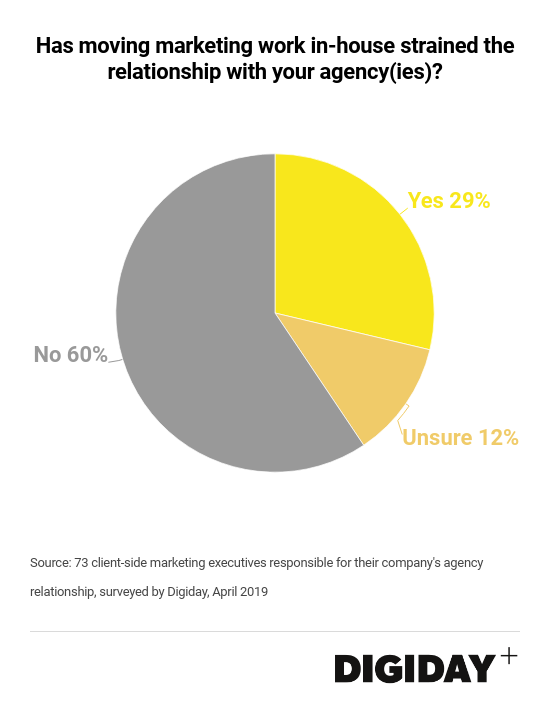
Clients are undeniably taking more work in-house, but that doesn’t mean they’re cutting off agencies entirely. That can make for a sticky situation. Roughly 30% of marketers building in-house capabilities said doing so strained their relationship with their agencies, according to 73 client-side marketers surveyed by Digiday this April.
But for most respondents, 60%, the shift to in-house hasn’t changed how they cooperate with agency partners. Meanwhile, another 12% of survey takers were unsure if their agency relationship has changed.
“There was a lot of tension, especially when there were talks of internalizing the whole programmatic stack,” said one marketing executive surveyed. Another respondent found their agency desperately tried to “pull a land grab for responsibilities” to protect certain areas of their work they deemed most profitable.
For at least one marketer, its agency has attempted to stymie its ability to do the work themselves. “Since in-housing, they’re more challenging to work with and have pushed back on our requests for help,” they said.
“They are definitely more suspicious of us,” observed another marketer. “In-housing had lead to some strains with our agencies regarding budgets, but also trust and expertise,” commented another.
Mike Boyd, svp of enterprise brand marketing at Nationwide’s in-house agency noted that upfront conversations with their agencies about why it made sense for certain portions to done internally, rather than blindsiding them, did not damage their relationship with their agencies, Ogilvy and Universal McCann. “These conversations can have potential economic consequences for them, but our external agencies are not the bad guys. They’re helping us be successful” he said.
In fact, some survey takers found that having building internal marketing capabilities improved their work with agencies.
“There’s more, clearer, and better direction on our part and more oversight on performance. The agencies are being held accountable so execution is improving and they are clear that they need to provide value,” said a survey taker.
“Rather than looking at us as clients, they started looking at us as partners,” said another marketer.
Marketers taking a greater share of the workload internally can also free up the agency to more important tasks. “Our in-house team allows our agencies to focus on bigger creative solutions rather than basic production work such as resizing ads or creating a simple ad from a bigger campaign,” one marketer said.


More in Marketing

Marketing’s upper middle embraces AI creative production
Scaled AI creative production is becoming ordinary among CMOS outside the billion dollar club.
‘It scared the hell out of me’: What brands have learned from creator partnerships
At Shoptalk Fall, brands like Favorite Daughter, SharkNinja and Bob’s Discount Furniture talked about what they’ve learned from working with creators.
Future of Marketing Briefing: Agency fees in creator deals are the next transparency headache for marketers
As creator marketing budgets grow, so do questions about what agencies are taking.