Digiday Research: Agency men and women see the big 2020 election issues very differently

This research is based on unique data collected from our proprietary audience of publisher, agency, brand and tech insiders. It’s available to Digiday+ members. More from the series →
Most men working at ad agencies see the economy and the environment as the two defining issues of the 2020 election season. For women, the picture is a little more complicated, despite both sets of respondents identifying as overwhelmingly liberal, according to Digiday Research.
A Digiday survey of 72 agency professionals found more than 60% of the survey’s male respondents listed the economy, and 50% listed the environment as top issues. More than a third of the men included coronavirus response in their lists.
By contrast, the top priorities for women were more spread out. Respondents were asked to choose their three most important issues out of a list of 14; none of the issues was named by a majority of the women who took the survey. The most commonly cited one, social justice, was on 41% of female respondents’ lists.
Just as agency and publisher professionals differed sharply in their view of the election’s top issues, there were significant disparities in how male and female agency professionals viewed most of the survey’s choices. More than a quarter of the women ranked gun policy among their top issues, but less than ten percent of the men did. Social justice, which more than 40% of women cited as a top issue, was named a top issue by around a quarter of men.
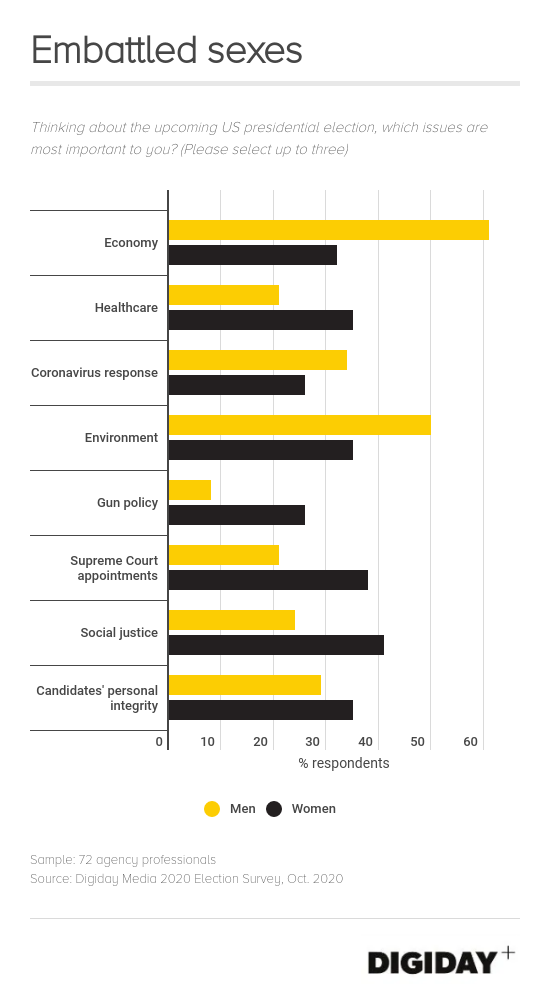
The two groups had more in common when it came to the issues they named the least. Both taxes and immigration were cited by fewer than 9% of respondents, and similarly slim percentages of male (13%) and female (9%) respondents cited economic inequality as a top issue.
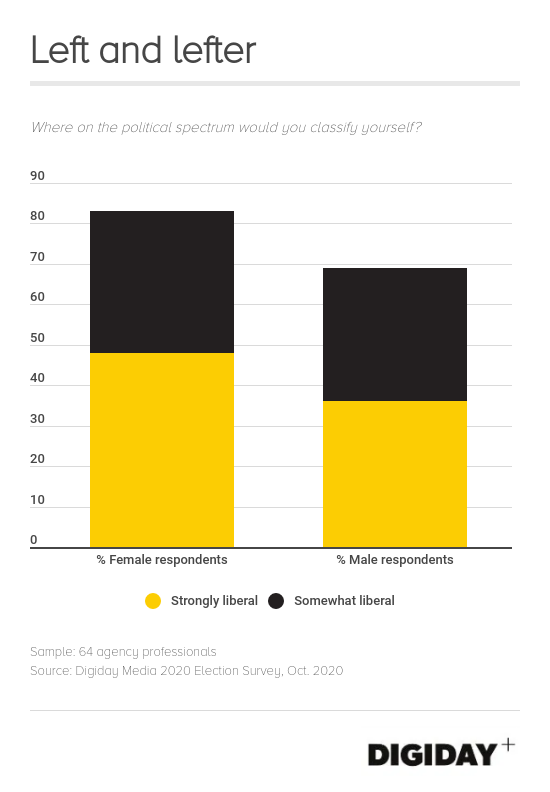
These big gaps belied the strong similarities in each groups’ political leanings. Significant majorities of both male and female respondents identified themselves as liberal, and identical shares of both groups identified themselves as conservative.


More in Marketing

From influencers to AI, here’s what Gen Alpha thinks about your brand
The Gen Alpha cohort now influences nearly half of total U.S. household spending in families with children ages 8-14.

At S4 Capital’s Monks, agents can run autonomously, unsupervised for days
S4 Capital’s digital agency now budgets for tokens and talent from the same pot.

Dhar Mann’s $100M AWNY deal target for creators is already pledged (so he says)
The goal with Dhar Mann as AWNY’s chief creator officer is to make it easier to make connections that are often held up by corporate red tape and too many layers between creator and CMO.