
There’s a narrative that’s taken place that takes as accepted fact that Facebook’s once ironclad grip on the fickle teen market has slipped, as evidenced by the surge of other apps like Instagram and Whatsapp, which Facebook paid a combined $20 billion to acquire.
It’s undeniable Instagram and Whatsapp, among others like Snapchat, which Facebook also reportedly offered to buy, are surging. But it turns out Facebook’s core service is doing just fine with teens. New data from Forrester bears this out, showing that Facebook is still the default social network with teenagers.
The researcher found that three quarters of teens said they used Facebook monthly, over twice that of Pinterest, Tumblr and Snapchat. Facebook use is more than Instagram and Whatsapp combined, according to Forrester.
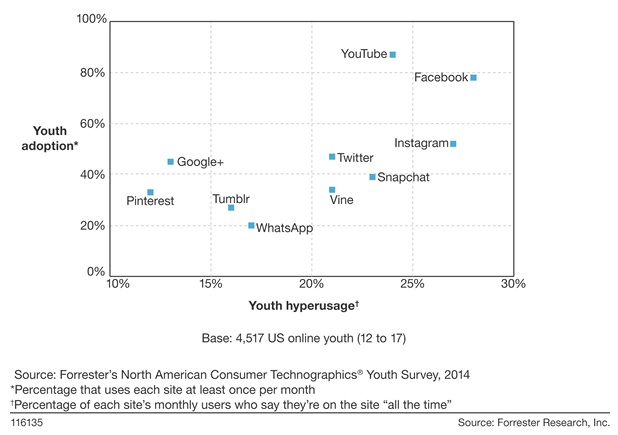
Forrester surveyed over 4,500 teens for the survey.
The data is a bit of an about face to the marketer view of Facebook. After all, it was only in October that Facebook CFO David Ebersman admitted teens were using the service less frequently.
“The bottom line: The sky is not falling,” Forrester analyst Nate Elliott, who has been critical of Facebook in the past, wrote in a blog post. “Facebook does not have a problem attracting or retaining teen users.”


More in Marketing

‘Predictability has become a luxury’: As the Iran war drags on, ad markets are starting to sweat
Whatever hope remained that this would be a short war is fading. And with it, the assumption that the economic damage would be too.

Walmart-Vizio’s CTV measurement faces incrementality hurdle
Walmart’s Vizio deal promises closed-loop CTV measurement, but brands are waiting for data clean rooms and proof of incrementality.

How E.l.f. Beauty is using AI to alleviate the workload of its workforce
E.l.f. Beauty’s chief digital officer, Ekta Chopra, shared the four pillars that guide the beauty brand’s approach to AI implementation.