Join us Dec. 1-3 in Nashville for the Digiday Programmatic Marketing Summit

Written by Pete LaFond, vice president of marketing, TruSignal, Inc.
If you’re a direct response marketer and your conversion rates are 100 percent, this article probably isn’t for you. For the rest of you looking to move the needle in your digital campaigns, continue on.
The premise of direct response campaigns is that they drive immediate results. As a marketing professional, you’re likely testing and iterating constantly to figure out how to optimize each channel to the nth degree, striving to squeeze out a few more new customers with an acceptable cost per acquisition.
The challenge is, no matter how many levers you pull, your campaigns always target a combination of high and low converters. But what if you could avoid many of the low converters? Here’s where NOT targeting (a.k.a. audience filtering) comes in to play.
Turning targeting on its head
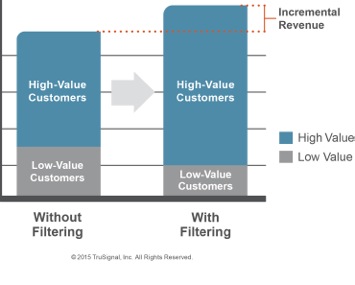
Audience filtering should be a critical part of your digital strategy. Audience filtering, also known as “exclusion targeting,” allows you to exclude people from your campaigns who are highly unlikely to convert. In turn, the money saved by not buying those people can be redirected toward advertising to quality prospects —people likely to convert with an attractive revenue-per-lead.
While it’s common practice to target the best prospects with the highest revenue-per-lead, you can also create extremely efficient campaigns by eliminating unlikely converters pre-campaign, before valuable resources are exhausted.
Not your typical exclusion targeting
Today, there are multiple ways to exclude audiences from your media buy, but most of the filters are either too specific or restrictive, thereby eliminating exclusion targeting at scale (e.g. if user A visited website X in past 2 days, then exclude from retargeting campaign). Or, they are so broad (age, geography, etc.) that you can’t utilize exclusion targeting without throwing the baby out with the bath water.
Audience filtering, on the other hand, uses your known customer data and predictive analytics to build a custom model to score people, one-at-a-time, and determine likelihood to NOT convert. Using this technique, you can pinpoint and eliminate specific individual poor performers who are dragging down your overall conversion rate. The result? Fewer wasted impressions and a lower CPA.
Put the new strategy to the test
It’s unlikely you’ll ever get a 100 percent conversion rate, but predictive audience filtering can reduce wasted impressions by 20 percent or more and get you one step closer to targeting nirvana. Understanding who to avoid can be just as powerful as understanding who to target.


More from Digiday

Stagwell buys Freestar, putting publisher ad sales inside a holdco
Publishers have long wished agencies would put their money where their panel talking points are. Stagwell has done something adjacent.

Midterm political spending throws spanner into regional advertiser holiday plans
Rising political ad spend is making life harder for regional and local brands hoping to use CTV ads to reach consumers in Q4.

Salesforce’s $5.7 billion Braze deal puts marketers at an ecosystem crossroads
The deal promises faster, more connected marketing, while raising questions about vendor lock-in and how brands stand out as AI automates campaign execution.