Join us Dec. 1-3 in Nashville for the Digiday Programmatic Marketing Summit

If communicating on Snapchat, Facebook, WhatsApp, LinkedIn, Twitter and other apps wasn’t enough to get your message across, Tumblr is launching its own private messaging tool it said in a blog post today.
Before this, the only way Tumblr users could communicate with each other was by reblogging posts with comments or its clunky and generally hated Fan Mail feature, which is being jettisoned for this. Now users can communicate privately and in real-time with threaded conversations, a feature Tumblr says had been among the most-requested.
Messaging isn’t available to everyone just yet. Tumblr says it’s using a “viral launch” with only 1,500 people getting the tool for now. More users will get it when someone with it messages them, creating a chain effect. (Everyone will have it by early December.)
But does this green earth really need another messaging service? Tumblr founder and CEO David Karp told Wired that, yes, it does because Tumblr’s community is based on strangers sharing similar interests who are looking to start conversations with each other:
“We’re not trying to take on Facebook through Tumblr messaging,” says Karp. “It’s really organized around this community of strangers who are obsessed with the same stuff, and being able to find each other and talk to each other… This should be the central feature, this should be the backbone for all the user-to-user and user-to-group interactions happening on Tumblr.”
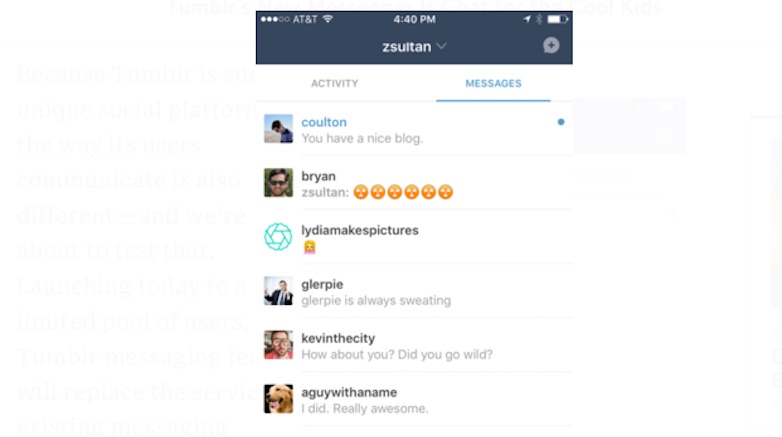
That’s different from competitors, like Facebook Messenger, where those communities are built around real-life friendships. Of course, having a complete strangers reach out and touch you is weird, so Tumblr has built-in safety tools, like limiting who can message them, if a user suffers from stranger danger.
For now, Tumblr says users can’t share the lifeblood of Tumblr, a.k.a. GIFs, but it’s working on it for future versions.


More in Media

As publishers await click data, Google’s AI visibility push complicates the opt-out decision
Google is moving on two fronts: working up the U.K’s Competition and Markets Authority-mandated search opt-out publishers have long sought, while enhancing AI Overviews in ways that could make opting out less appealing.

WTF is the AI training opt-out policy token?
Major AI companies are backing a new AI training opt-out standard proposal for publishers, but it exposes deeper tensions over AI scraping.

Creators see promise in Instagram’s long-form push, but question whether exposure is enough
Instagram wants to pull long-form creators away from YouTube, but is it offering enough? Experts weigh in on the platform’s pivot.