Facebook has been very good to Moviepilot — for now. But the site for film buffs isn’t about to rest on its social laurels.
Ever since Moviepilot adopted a platform approach a year ago, traffic has more than doubled to 14 million monthly uniques in May, according to comScore, making it the sixth-biggest site for film buffs behind such sites as IMDB (71.5 million uniques), Fandango (37.5 million) and Flixter (17.4 million). And fully 80 percent of Moviepilot’s traffic comes from Facebook, through the publisher’s 13 pages and 29 million Facebook fans.
Such dependence can come with risk, though, given Facebook’s history of changing its algorithm. All it would take is a tweak, and Moviepilot’s traffic (and its advertising revenue) could disappear. So Moviepilot is launching a new “digital magazine” here that it hopes will Facebook-proof the site.
Today, Facebook incentivizes articles that are highly shared, said Moviepilot CEO Tobias Bauckhage. That favors broadly popular articles, but Moviepilot’s bread and butter is niche content that appeals to rabid fans of, say, horror movies but doesn’t necessarily lend itself to sharing.
Using himself as an example, Bauckhage said that despite being a Harry Potter fan, he doesn’t share content about the films on Facebook “because people will think I’m an idiot.” Therein lies the rub: “The sharing signal over the past year seems to be more and more important in the algorithm,” he said. “That concerns me a little bit.”
The move comes as advertisers also are starting to look more critically at sites’ traffic. It used to be enough to show big audience numbers. Increasingly, though, sites are eager to demonstrate their audiences are engaged (and presumably more likely to see the ads) through metrics like pageviews and time spent on site.
If the typical Moviepilot reader comes via mobile device and reads one or two articles before bouncing back to Facebook, the idea behind the digital magazine is to create a stickier reading experience, with 15 to 20 articles devoted to a specific theme, updated monthly. The idea is that even if people still discover the magazine content through social media, they’ll like what they find.
“Facebook is the reason we’ve all grown so much,” Bauckhage said. “It’s also scary. What we’re really trying to do is increase our relevance. This is our best defense to be independent. If you can show you can build something on social media that’s really relevant, you can build a real media company.”
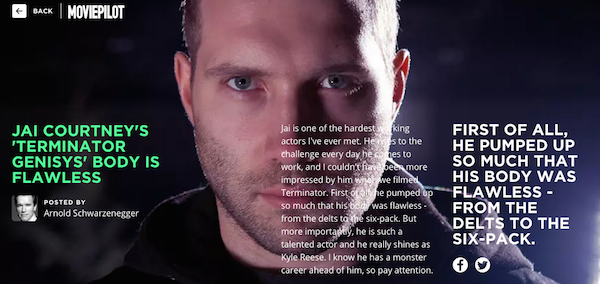
With the magazine, Moviepilot is also going outside its fan contributor model. The magazine, led by Bauckhage’s co-founder and Moviepilot chief creative officer Jon Handschin, will feature creators and celebrities in addition to articles by the site’s best contributors and writers. The first issue will feature posts by Arnold Schwarzenegger (shown below) on his “Terminator Genisys” co-star Jai Courtney, and Ridley Scott promoting his new film, “The Martian.”
The celebrity approach also speaks to the way celebrities increasingly are looking for ways to control their social media presence and skip the intermediary to share their messages directly with their fans, through sites like WhoSay.com and Derek Jeter’s The Player’s Tribune.
“Any talent that can disintermediate anything that comes between them and their fans is going to be interested now,” said Rob Gregory, chief revenue officer at WhoSay. “Moviepilot is giving them a chance to engage.”
Image courtesy of Moviepilot.


More in Media

Time pitches GEO insights into a new brand offering
Time is turning its AI insights into a new product, selling branded content to shape how brands are talked about inside AI-generated answers.

Why The Guardian’s first reader-facing AI product isn’t a chatbot
The Guardian has begun to roll out its first reader-facing AI product. But it doesn’t really look like an AI product.

CreatorIQ and Sprinklr bet they can solve creator measurement’s fragmentation problem
CreatorIQ and Sprinklr are joining forces to bring creator intelligence, social media management, and paid amplification onto a single platform to try and solve a creator marketing problem.