Prices rise for the Digiday Programmatic Marketing Summit after Mar. 24
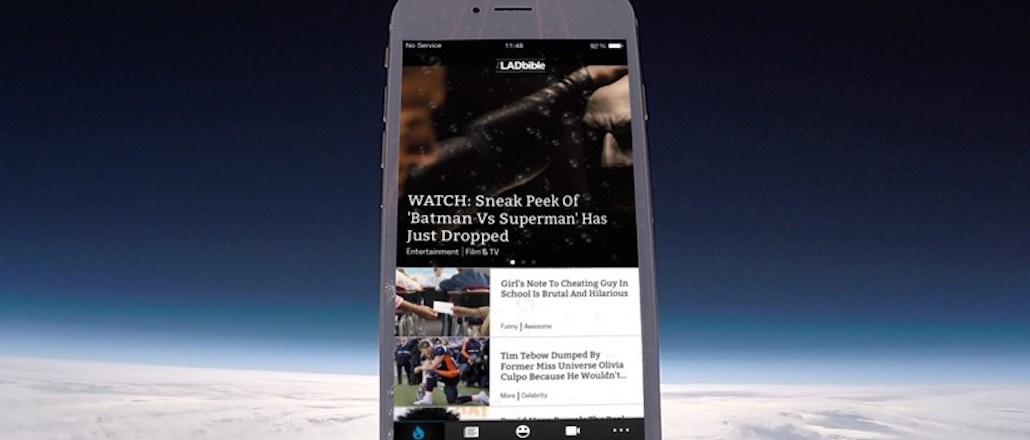
The Lad Bible has been trying to shed its beer-and-blokes image by covering more serious news content, a strategy that has extended to its first app on iOS. We talked with James Wigley, The Lad Bible’s commercial director, about how the publisher creates content for individual platforms and why it takes a conservative approach to display ads.
Why launch your first app now?
Our audience is young, mostly male and 85 percent mobile, so all our business is aimed at serving that, whether it’s our own site, Facebook, Instagram, Twitter, Snapchat, Vine or YouTube. The app was the next logical step.
How are you monetizing it?
It’s a mix of display, branded content and video pre-roll. We take a patient approach to monetization. One of the most significant decisions I make is often about when not to monetize. For instance, if we serve you a piece of video content under 60 seconds, we aren’t going to serve a 30-second pre-roll ad ahead of it.
What else do you have in the works?
In the new year, we’ll be rolling out apps for The Sport Bible, and then we’ll look at our other brands and ramp up our user-generated content-licensing business, The Content Bible.
Our mobile focus is very much on video and branded content. Our video team is expanding quickly, and next year, we are going to power-up our original storytelling. We’ve had some good results on Snapchat and Instagram with original video content, which has given us a sense of what is possible.
So what’s done well for you?
We did an exclusive feature for David Hayes’ comeback that received 1.3 million views on Facebook in the first 24 hours. A pared-down version on Snapchat received 1.9 million in 24 hours. Usually, we see more views on Facebook, but this shows us that Snapchat is increasingly an important part of our mix.
https://www.youtube.com/watch?v=FIcruPI9NA4
What about branded content?
We did a “12 Hour Holiday” campaign with Doritos and OMD where they challenged our guys to have a holiday in Ibiza and be back to their desks by 9 in the morning. We created video for our website, streamed elements of the challenge on Periscope and Twitter, ran a short trailer on Instagram and used Snapchat for behind-the-scenes clips, which delivered a million Snapchat views in 24 hours. We obviously tailor content for where it’s going to sit: On Instagram, our video pieces are cinematographically beautiful; Snapchat is more raw and gets people closer to the story. Some media owners think of themselves as platform-agnostic, whereas we’re more platform-specific.
Young men are more likely to turn on ad blockers. How is this impacting you?
It’s not a massive issue for us. Ad blocking is a symptom of users who won’t stick around if you serve them a page with 100 different tags that eat up time and data. This is just the reality.
Images courtesy of The Lad Bible.


More in Media

Joint signings highlight growing convergence between creator and Hollywood agencies
What a spate of joint signings between Reign Maker Group and Paradigm Talent Agency tells us about diversifying talent and owning media in the creator economy.

News/Media Alliance signs AI licensing deal to unlock recurring RAG revenue for small and mid-sized publishers
The News/Media Alliance has signed an AI licensing deal that lets its 2,200 publisher members opt in to monetizing RAG-driven enterprise demand.
Why Parker Thatch transformed its strip-mall storefront into a livestreaming studio
Parker Thatch recently remodeled its store to serve as a hybrid customer-facing retail experience and broadcast studio.