Join us Dec. 1-3 in Nashville for the Digiday Programmatic Marketing Summit
Checking Out: Check-in applications have a long ways to go before they’re mainstream. A recent study about consumers’ use of mobile commerce tools commissioned by clothing company Liz Claiborne found that the majority of participants were enthusiastic about using certain mobile apps, like mobile coupons and product search, but not about social location apps. Out of seven mobile actions that consumers expected to use more in the future, check-in apps came in last. Foursquare is aware that it needs to make checking in valuable if it wants to remain appealing to users and has recently signed partnerships with daily deals sites like LivingSocial and Groupon. That’s the big test if they’re going to break through to the regular people. GigaOm
Twitter Traits: You’d be surprised how much you can actually tell from someone’s tweets. According to a new paper from researchers at the Mitre Corporation, “Discriminating Gender on Twitter,” you can tell someone’s gender from their tweets. Here is one particularly entertaining dataset they found regarding gender-skewed words:
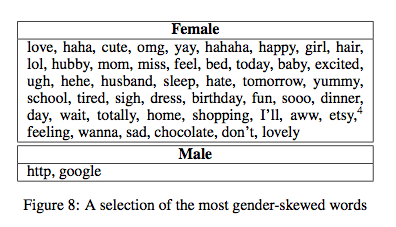
Other unsurprising demographic predictors they found were that tweets containing exclamation points, emoticons, abbreviations (like OMG), repeated letters (“nooooo”), and expressions of affection (“xoxo”) were likely from a female author. Fast Company
Get Paid to Hack: It’s a good time to be a hacker if you are looking to make some extra money. Facebook just announced its new “bug bounty program,” which offers hackers a minimum of $500 for information about security flaws, as long as the hacker agrees not to disclose the flaw until the company has fixed it. Microsoft and Google now also offer similar programs. Happy hacking. HuffPo
Video of the Day: Cash Cab, Living Social style.
Infographic of the Day: There is a direct correlation between Justin Bieber’s tweets to his female fans and his sales the following day. Belieb it. AllTwitter


More in Media
The Hill adds interactive election tools to subscription offering ahead of the midterms
The Hill is betting on interactive subscriber-only features to help grow its new subscription business ahead of the 2026 midterms.

The Daily Mail tests GEO with brands ahead of AI visibility product
The Daily Mail is running around a dozen GEO tests to work out what works before turning its AI visibility offering into an official product early next year.

Meta delays rollout of updated commercial terms amid publishers’ collective pushback
Meta’s updated commercial terms have galvanized publishers into a coordinated pushback over the company’s use of their content.