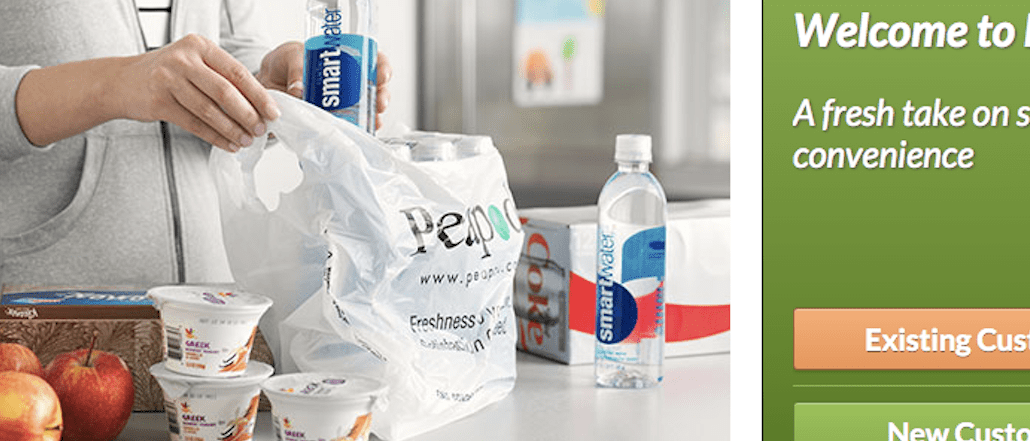
Online grocery delivery company Peapod has been around, almost shockingly, for 30 years. One of the Internet’s first startups, it has survived by adapting and innovating. It has paid off: This year the company will see half of all orders coming from mobile. A full third (34 percent) of its customers don’t even use desktop at all — up from 25 percent last year.
Shopping is, increasingly, all about convenience, something that Peapod understood when it launched its site in 1996. Now, however, “convenience” means mobile, a fact not lost on CMO Carrie Bienkowski. Today a quarter of its first-time users start and end on their mobile devices, according to Bienkowski.
In order to keep up with the trend, the company developed its own mobile and tablet app as well as a mobile-friendly site two years ago, which “should have been done earlier,” said Peapod’s CEO Jennifer Carr-Smith.
The online grocery delivery further redesigned its app last year to let users search by keyword or by scanning a barcode. The new app also allows shoppers to create a list of favorite brands and scan a list of previously purchased items for fast selections.
Aside from an app and a mobile-friendly site, the shift to mobile also means using more data to improve customer acquisition and retention rate, said Bienkowski. Having worked for eBay and PayPal before, she told Digiday that the best consumers shop eBay around an average of 3.7 times a year, 19 times for PayPal. In comparison, e-grocery shopping sees a much higher transaction rate because it’s in the consumer’s consideration every week.
“Every transaction on Peapod entails an average of 50 or 60 items. Because of the frequency and the volume we started collecting lots of data with more coming from mobile now,” said Bienkowski. “So there’s a lot we can do in terms of personalization, making grocery shopping experience as relevant as possible.”
For example, more than 50 percent of Peapod orders have at least one organic item in them. When an organic consumer logs in, Peapod will recommend organic items for the consumer and automatically filter non-organic options.
Meanwhile, Peapod has built a merchandising tool to analyze what is in a consumer’s existing basket and compare that with their historical transactions. Based on the data analysis, Peapod sends the consumer a reminder two hours before their update is cut off, recommending 12 items that the consumer might have forgotten.
“We just scratched the surface in terms of personalization on both mobile and desktop. It will become a huge focus for us in the future,” said Bienkowski.
https://twitter.com/PeapodDelivers/status/707599111298662400
Going forward Peapod is also looking to do more native advertising on mobile to integrate delivery experience into the consumer’s daily life, as well as collaborate with influencers on social to create excitement over food.
“We should think more like a fashion retailer to tap into the micro influencer communities and inspire great content,” Bienkowski added. “But we don’t want to focus [only] on a young audience because the notion of online grocery is not just for millennials.”
E-grocery is estimated to reach $88 billion by 2018. With entrants like FreshDirect, Instacart and AmazonFresh flocking into the business, Bienkowski and Carr-Smith think that competition normalizes the behavior of online grocery shopping. They don’t worry about newcomers too much because the cost of disrupting this sector is very high.
“Competition is always good. Online grocery is a high-capital investment because you need a supply chain, a distribution system and a delivery network,” said Carr-Smith.


More in Marketing

Indie agencies want The Trade Desk and Amazon DSP to acknowledge their buying power with negotiating leverage
Indie agencies say DSP giants block direct seats and fee relief despite spend commitments.
Nearly 30% of holiday budgets expected to be spent by the end of October
Per a new report from Deloitte, 28% of shoppers’ budgets are expected to be exhausted by the end of October.

Apple finally explains its Safari block, and identity companies are in its sights
As Apple spells out its case for blocking identity companies in Safari, its job board shows an ads business with big plans.