Join us Dec. 1-3 in Nashville for the Digiday Programmatic Marketing Summit
In Graphic Detail: Inside the scramble to measure a brand’s AI visibility

Marketers are catching on that AI doesn’t rank their brands, it decides whether it gets brought up at all. That shift is already reshaping how the industry works. The Interactive Advertising Bureau (IAB) has been assembling a framework meant to standardize how that visibility even gets measured since there’s no agreed baseline for what good data collection looks — like let alone what actually drives a recommendation.
Inside companies, the uncertainty is showing up in headcount. Heads of AI search are getting hired because the honest answer right now is that nobody quite knows how this works yet. And some brands aren’t waiting for anyone to figure it out. They’ve started moving ad budgets around specifically to shape how a chatbot describes them when asked.
Reddit’s sudden drop in ChatGPT recommendations shows why brands are moving on all these fronts at once, not waiting to see which one matters most.
Below is a graphical snapshot of many of the underlying factors behind the urgency.
There is no single playbook for AI visibility
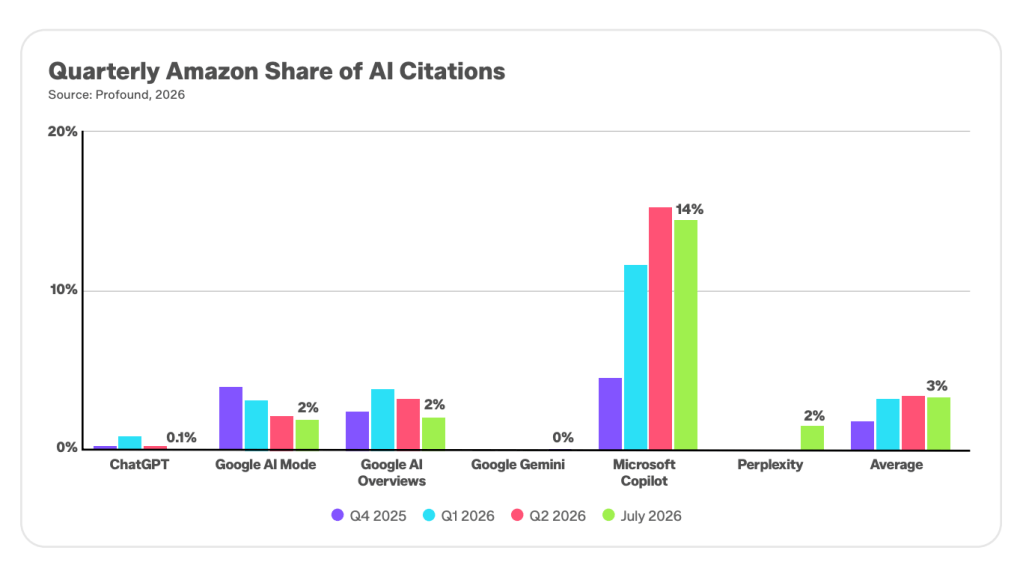
It’s not a new observation but it gets clearer with every data point. One LLM’s go-to source for information is barely an afterthought for another. Staying on top of that — platform-level citation — behavior matters more every day as marketers build out their AI search and commerce strategies. Take Amazon, for instance. Its visibility varies wildly by platform, accounting for 4% of Microsoft Copilot citations in July, just 0.1% on ChatGPT and zero on Gemini, per data from Tinuiti. That outsized Copilot performance is materially lifting its average citation share across product categories.
“We’re now influencing discoverability across a multitude of surfaces,” said Angela Seits, Dept’s vp strategy. “We’re focused on guiding clients to think about how they’re building content for all the ways that people interact with their brand, and making sure they’re showing up in the right results within that greater system.”
No single system, either
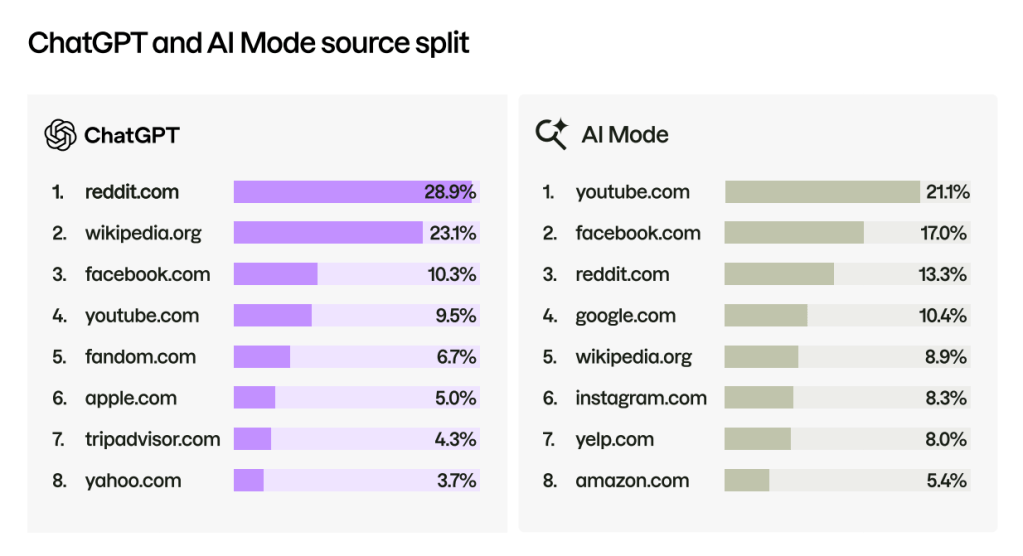
Like humans, LLMs have preferences and marketers are grappling with that. Two LLMs might name the same brands in response to a question about sneakers, but they tend to reach for different sources to prove it. ChatGPT, for example, tends to prefer community and reference sources, according to Adobe’s Semrush’s study of U.S. data across 22 categories between January and June. Reddit, the AEO company found, is ChatGPT’s number one source with 28.9% of every citation it makes. But Google turns to video and social. YouTube is its number one at 21.1% and Facebook is number two with 17%.
“There is no silver bullet in any of this,” said Gabe Feldman, co-founder and managing partner of The Now Agency. “It’s YouTube, its schema on your website, its PR, its creators, its publishers, all working together. If you’re only focused on one of those you’re missing the bigger picture.”
Even YouTube isn’t a sure thing
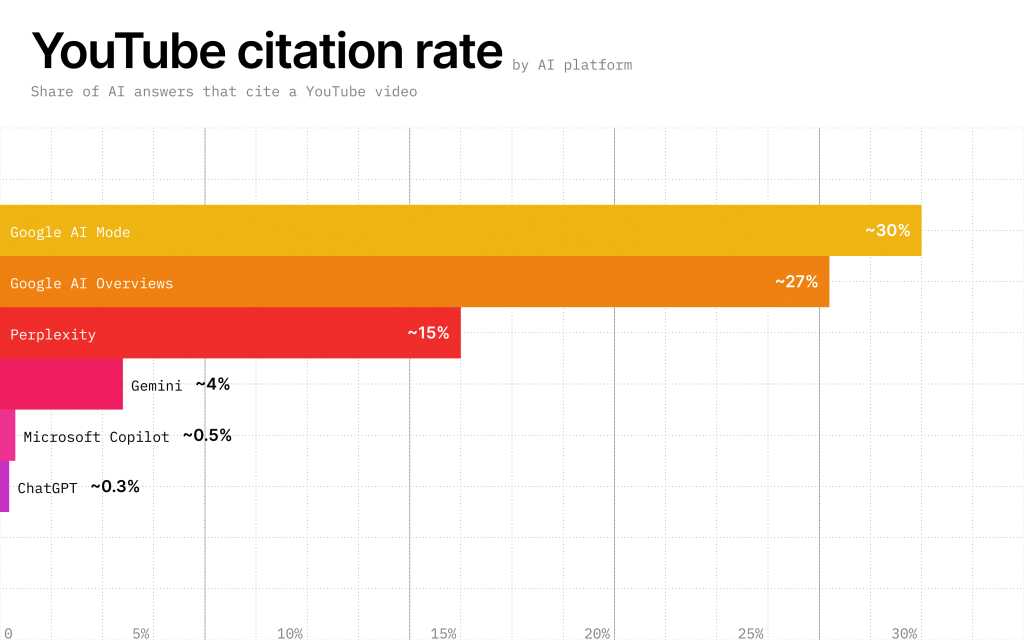
It’s worth taking claims of universal LLM preference for YouTube with a pinch of salt. Yes, it’s likely to be cited by the most prominent AI platforms but that lift skews in some surprising, and not so surprising, ways. Google AI Mode, Google AI Overviews, Gemini (well, sometimes) and Perplexity all cite YouTube regularly, according to an analysis of AI answers measured the same way across all four platforms by Sitecore’s Scrunch between May and July. ChatGPT and Microsoft’s Copilot, not so much.
Trust in AI is growing faster than marketers can adapt to it
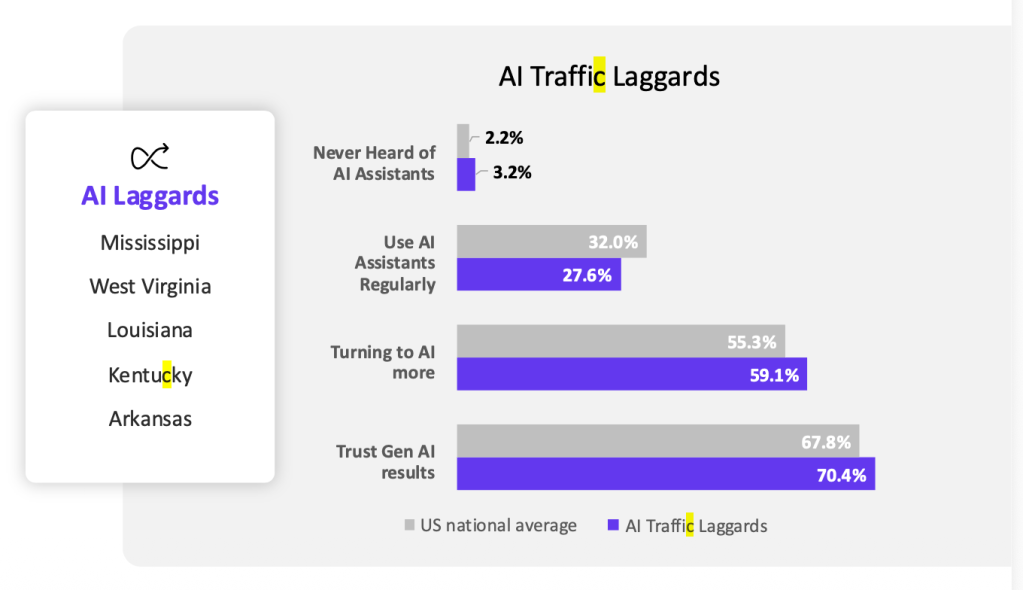
According to the July 2026 Adobe Consumer Survey of more than 5,000 U.S. respondents, most (95%) people who turn to AI find its respondents at least as trustworthy as a traditional search engine, including 29% who call it very trustworthy. That trust climbs with familiarity, per the research, but it starts high everywhere. Some 9% of non-users already rate AI at least as trustworthy as search, rising to 94% among experimenters and 97% among regular users. Surviving that paradigm, let alone thriving in it, is something many marketers are only now starting to work through. They’re checking whether a creator already shows up in AI-generated answers before a campaign event starts, folding that criteria that used to run on reach and engagement. Some are building tools to measure where they actually stand in LLMs, tracking which sources get cited and why rather than guessing, Then there are those who are turning the same scrutiny on themselves running their own executives’ content, investor calls and CEO updates through the same test a creator’s video would face.
“I think we’re going to see AEO have the same seat at the table as some of the largest media channels we’re used to seeing,” said Crystal Duncan, evp of brand engagement at Tinuiti.
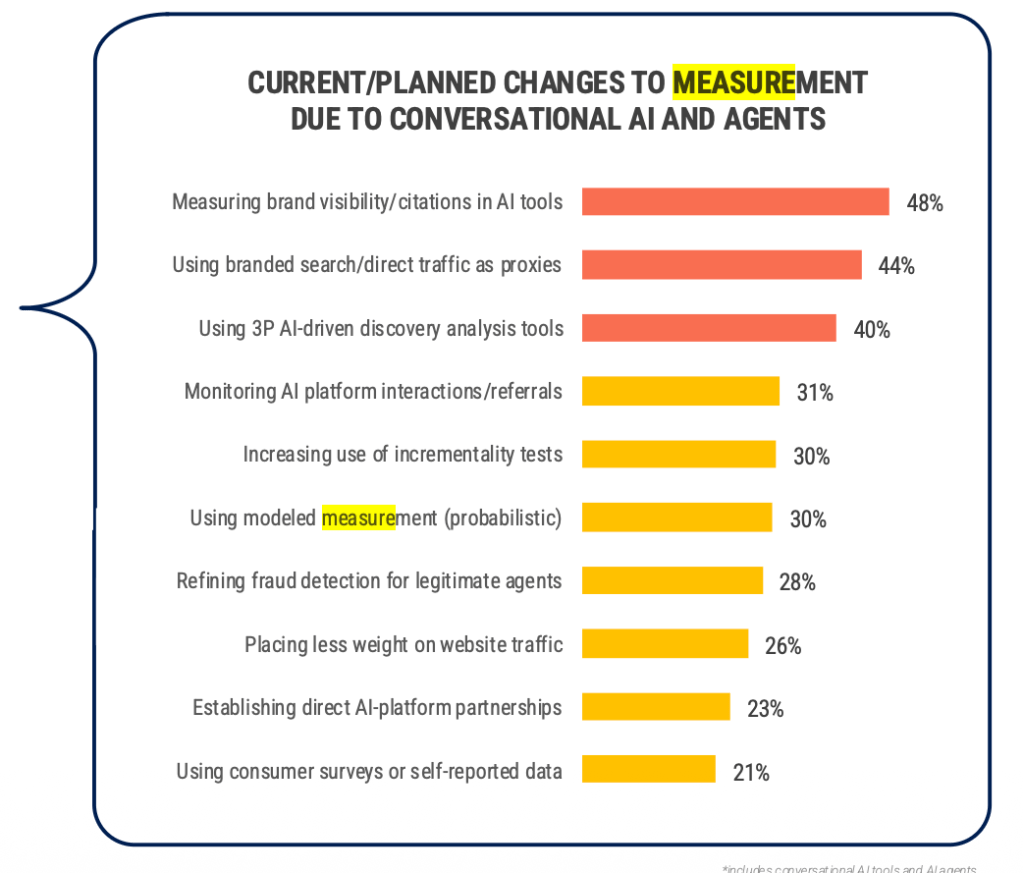
Measurement is struggling to keep pace
When has it not, in fairness. But the gap here is wider than usual. The same prompt can return a different answer nearly every time it’s asked, which makes the basic act of scoring a brand’s visibility a moving target rather than a fixed number. Even a fixed number wouldn’t hold for long. Every time a model gets an upgrade, whatever a brand has been tracking can shift overnight. Nothing about the brand changed, The model just started remembering more.
That instability is already spilling into open disagreement among the companies selling the measurement itself and it’s nudging CMOs to ask harder questions about what building a brand even means now. It’s also spurred the IAB into building standards that at least give buyers a shared definition of trustworthy data, even if nobody agrees yet on what a trustworthy score actually looks like.
All that helps explain why marketers say measurement is the biggest challenge they’re grappling with now, especially, when it comes to comparing AI-driven versus traditional customer journeys. Nearly half (45%) of the 200 brand and agency ad investment decision-makers surveyed by the IAB said that was the case.
“We’re all trying to figure out in real-time how to do this work when the models aren’t deterministic,” said Caroline Giegerich, vp of AI at the IAB, who led the four-month effort behind the trade body’s new framework for measuring AI visibility. “The market is messy. It’s hard to do measurement because you could run ‘what’s the best sneakers for under $200?’ and get different results 100 times. As a marketer, what do you do when that happens? You could also get different results for different models. And again, as a marketer, you have to ask how to measure that.”


More in Marketing
In Graphic Detail: What Apple’s identity block means for the ad money
How Apple’s identity block hits publishers’ wallets, and why Apple can afford it.
Anthropic’s ad bill is soaring, according to IPO filing
Anthropic’s IPO filing shows an ad-free AI company with a fast-growing ad bill.
Salesforce’s $5.7 billion Braze deal puts marketers at an ecosystem crossroads
The deal promises faster, more connected marketing, while raising questions about vendor lock-in and how brands stand out as AI automates campaign execution.