Join us Oct. 26-28 in Newport Beach for the Digiday Media Buying Summit

The world of advertising technology is a confusing one, and as venture capital money flows into the space the Lumascape slides beget even more. Simplicity, much talked about, doesn’t seem likely to arrive anytime soon.
This is fueling the need for a new, critical agency function, says Mediasmith CEO David Smith: the media technology planner. As evidence, Smith produced his own version of the Lumascape just for his own midsize agency. It is dotted with logos that would challenge even the most hardened ad-tech vets.
“Mediasmith reached a tipping point in 2011. We now see more tech companies than media publishers to get our jobs done,” said Smith, revealing that his agency’s current technology stack incorporates the services of over 40 vendors.
Here’s what the ad-tech world looks like to one agency:
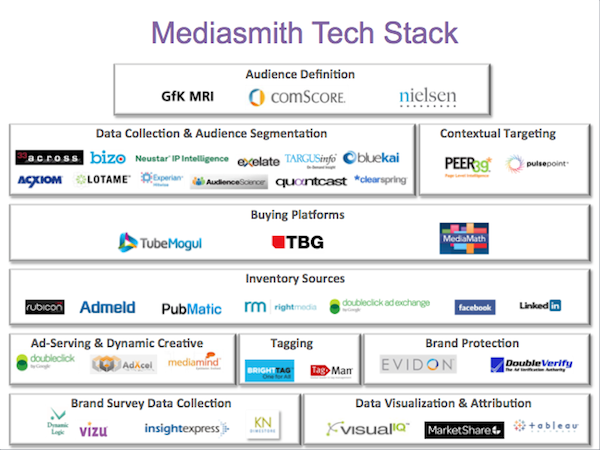
There’s little doubt that the ad tech world is confusing. Even the Lumascape’s author himself has recently taken to decrying “duplication” problem and predicting a round of “capitulation” deals where well-funded ad tech firms’ investors take serious haircuts.
Sorting through that mess is a full-time (and critical) job, Smith said. Day-to-day, the media tech planner will be tasked with researching and evaluating ad technologies, Smith suggested, from which he or she will piece together technology stacks tailored to the needs and goals of specific clients, or perhaps even campaigns. It’ll be about identifying and eliminating agency and client pain points, ultimately.
“It’ll be a combination of research and development work, as well as work with media planning groups; the people executing and evaluating these plans,” he said.
According to Smith, the rise of the media tech planner will be echo that of the media planner in the 60s. Until the advent of data such as those provided by Nielsen, Simmons, and ARB, account executives and media directors made planning decisions based on crude estimations.
But ultimately the rise of audience data birthed the standalone media planner role, just as the emergence of ad technology will pave the way for the media tech planner.
Smith acknowledged that investment in this type of role will likely be underfunded to begin with, but suggested its importance will only become more prevalent as ad technologies continue to proliferate and fragment.
“This needs to be structured so that all of these technologies that being brought by various publishers go through some sort of funnel and vetting process,” he explained.
Asked by an audience member at The Digiday Conference what such a role would pay, Smith was coy, adding “not enough.” Some things in the agency world change, some don’t.


More in Marketing
‘Mission and capital can coexist’: Golden State Valkyries’ Jess Smith on pitch to sponsors
The WNBA’s newest team must navigate measurement demands and marketers wanting to share in the ‘mission’ if it’s to establish a commercial foothold.

Future of Marketing Briefing: Why top creators are taking fewer brand deals
The biggest creators are cutting their brand rosters and asking more of the partners they keep.

‘There’s nothing wrong with being a heritage brand’: How Revlon is updating its image by looking to the past
Revlon named musician and actress Teyana Taylor and country music star Megan Moroney as the faces of its “Revlon Be Unforgettable” campaign.