Join us Dec. 1-3 in Nashville for the Digiday Programmatic Marketing Summit
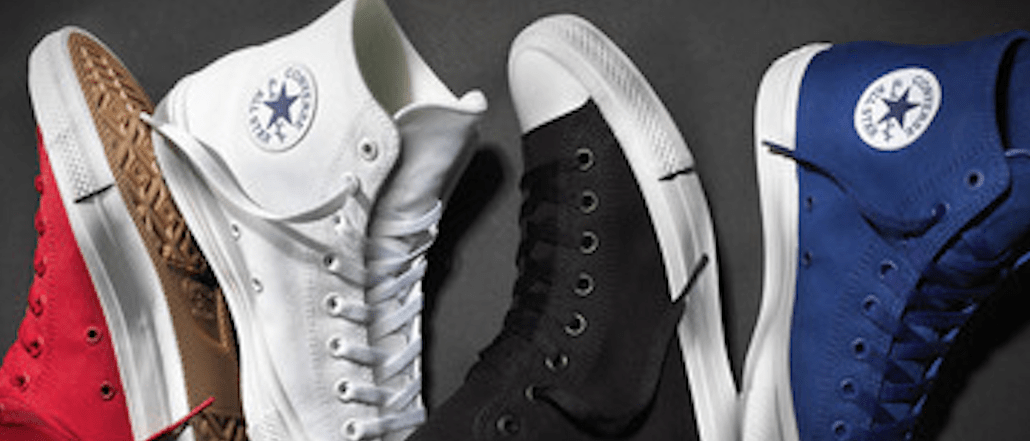
Cry your eyes out, punks. Converse has revamped its classic Chuck Taylor All Star high-top shoe to be the least grungy thing ever: comfortable.
The 107-year-old shoe company has seen very healthy sales in the last year, and this is due in no small part to the enduring popularity of the All Star. According to Fast Company, All Star sales made up a majority of Converse’s $1.7 billion in revenue in 2014. Not bad for a shoe that has been virtually unchanged since 1949.
So if it ain’t broke, don’t fix it, right? Not if you’re Converse. Nike bought the brand after it went bankrupt in 2003, so the new design includes some frou-frou innovations aimed at making the sneaker more comfortable: Lunarlon sockliner (huh?), a padded non-slip tongue (alrighty!), micro-suede lining (sure!), and premium canvas (hmm…).
The sneakerheads at Complex, Sneakernews.com and Hypebeast have reviewed the shoe favorably, which might speak to the Nike-fication of sneakers in general. All Stars date back to an era when arch support was practically unheard of. That changes with the shoe’s sequel, which remains true to the spirit of the iconic design. “The apple may not have fallen far from the tree, but the core is definitely leaps and bounds better than Converse’s first fruit,” Jian Deleon wrote for Complex.
Despite the changes to the inside of the shoe, then, it remains the All Star shoe people know and love on the outside — which accounts for the overall positive sentiment. The core complaint about Chucks has always been that they’re uncomfortable, not that they look unfashionable. Topsy records a little over 15,000 Tweets about Converse in the last 24 hours, with a majority positive sentiment over the last 24 hours:
chuck taylor IIs tho pic.twitter.com/xjIsbSjfNe
— Christopher Reath (@reathchris) July 23, 2015
People shared their feelings on Twitter, and indeed it proved difficult to find too many horrified purists:
DEF gonna get me a few pairs of the Chuck Taylor II shoes. — PAME GAUSED (@PharaohAmaranth) July 23, 2015
The new Converse #ChuckII tho #mustcop — Zyman Langley (@_ZL3_) July 24, 2015
they say don’t mess with a classic but this one sounds ok https://t.co/zeSUhwHQfI — Ivan Brandon (@IvanBrandon) July 23, 2015
I….love them? https://t.co/1P5UcvwdAs
— Nick Ghanbarian (@nickbayside) July 24, 2015
Some even think the design is better than the predecessor:
Converse Chuck Taylor 2: A less ugly Chuck Taylor — Mom Bod (@Brettsloan) July 23, 2015
I’m excited because Converse announced the Chuck II with cushioning and foot support. I’m an old fart.
— bored with names (@pookasaur) July 24, 2015
My body is ready for the Converse Chuck Taylor All Star II — ☆_☆ Veenerz (@mangu_vianie) July 23, 2015
Then there’s this guy!
If you’re wearing a Converse you’re basically wearing a Nike because Nike bought Converse way back in—wait for it—2003. #mindblown — Adit (@ohaiadit) July 24, 2015
There are a few out there mourning the loss…
Those new Converse designs are doing nothing for me. I’d much rather keep the old ones I currently have with three large holes in them.
— Daniel Collier (@JoyDivisionDan) July 24, 2015
so salty that converse is changing their design
— Madison McMahan (@madisonxann) July 24, 2015
I do not approve of Nike’s new version of Converse… They’re gross looking and I am very upset
— Angelica Rowell (@Jellylovee) July 24, 2015
But they needn’t worry: Fans of the old school kicks will still be able to buy the original, unlined Chucks for $60 a pop — and laugh at the preppies paying $75 for their Nike-fied shoes — come Tuesday, July 28.


More in Marketing
In Graphic Detail: What Apple’s identity block means for the ad money
How Apple’s identity block hits publishers’ wallets, and why Apple can afford it.
Anthropic’s ad bill is soaring, according to IPO filing
Anthropic’s IPO filing shows an ad-free AI company with a fast-growing ad bill.
Salesforce’s $5.7 billion Braze deal puts marketers at an ecosystem crossroads
The deal promises faster, more connected marketing, while raising questions about vendor lock-in and how brands stand out as AI automates campaign execution.