Join us Dec. 1-3 in Nashville for the Digiday Programmatic Marketing Summit

Natural beauty brand L’Occitane is reporting that it has seen a big success in its beta test of Facebook Canvas, the social network’s immersive mobile ad format debuted this past February.
L’Occitane started experimenting with Canvas in December of last year, prior to the ad offering’s official release. Within two weeks, the campaign reached 2.3 million Facebook users, resulting in 11 percent higher ad recall compared to link ads, as well as an average of 34 seconds engagement time, according to the company.
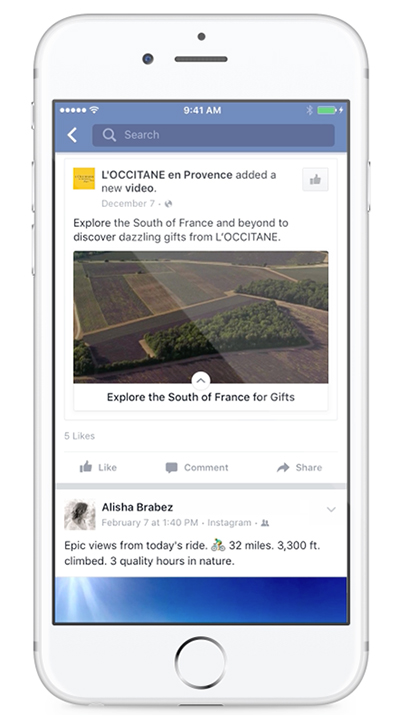
While those are presumably good numbers, L’Occitane did not readily make available pre-Canvas reach and recall. Still, a dwell time (the time spent on an ad) of 34 seconds is an increase from the standard completion rates on normal video ads, according to Thalie Farinaud, senior director of e-commerce for L’Occitane USA.
Farinaud declined to disclose the pricing of Facebook Canvas, but she told Digiday that it was a smart investment because Facebook advertising is all about storytelling and Canvas helped the brand tell authentic stories to interact with consumers old and new.
“Our goal [for Facebook advertising] is to give customers a strong understanding of L’Occitane by highlighting the true stories of our products,” she said. “Facebook Canvas helped us draw in new customers. The story was told through videos, images and brief copy, and it maintained viewers’ attention through to the end.”

In L’Occitane’s case, Facebook Canvas is appealing because it enables the brand to build an integrated product experience on mobile as well as add e-commerce elements.
When viewers swipe left or right, they will get more information about L’Occitane’s natural ingredients, such as their origins and implications. When they scroll up and down, they will enter different product categories like Shea Butter and Gift Set. They can further view detailed offerings under each category by swiping left or right.
L’Occitane added a “Shop” call-to-action button at the end of each category, which directs viewers back to the company’s site where they can make a purchase.
While the majority of L’Occitane viewers on Canvas engaged with the final call-to-action, other mobile users may not be willing to watch ads till the end in a closed environment.
“It is always a question with how to scroll and meet that opportunity to make your content impactful,” said Noah Mallin, senior partner and head of social for MEC North American operations.
It is not technically difficult to create a Canvas — Power Editor offers a code-free approach and a few templates. But if advertisers want to retain viewers from start to finish, they not only need to develop great creative but also add utilities to their content.
“Canvas advertisers also need to use the data available to optimize their content. For example, they are able to see various aspects of interactions such as when viewers swipe right,” Mallin said.
Facebook Canvas could be an ideal opportunity for brands like L’Occitane that are looking to nurture a long-term relationship with their Facebook fans. However, said Mallin, Canvas may not be a good fit for direct-response advertisers because it cannot offer consumer responses immediately.


More in Marketing
AI boosts discovery but reviews still seal the deal, new research shows
ChatGPT is where 16% of shoppers start looking for products. However, only 9% go there to actually buy something.

Future of Marketing Briefing: Advertisers have more ways than ever to choose a holdco, and free holdcos to choose from
Fewer holdcos, more ways to pick one: inside the changing agency pitch.
Walmart Connect pitches brands directly as it pushes lift studies ahead of holiday ad deals
Walmart Connect is using lift studies to prove ad performance directly to brands ahead of the holidays, signaling a tighter race with Amazon.