Join us Oct. 26-28 in Newport Beach for the Digiday Media Buying Summit
Future of TV Briefing: Netflix’s VOID peeks at the future of virtual product placement

This Future of TV Briefing covers the latest in streaming and TV for Digiday+ members and is distributed over email every Wednesday at 10 a.m. ET. More from the series →
This week’s Future of TV Briefing looks at an AI tool developed by a team including several Netflix employees that could presage the evolution of virtual product placements.
- AI-generated product placement
- DOJ’s NFL investigation, Paramount-WBD’s industry opposition and more
AI-generated product placement
Earlier this month, a group of AI researchers, including several Netflix employees, unveiled an AI tool that can be used to remove objects from video clips.
Which is underselling it.
The AI tool not only photoshops out objects but also the objects’ effects on the scene. And if it can be used to erase the traces of objects from scenes, couldn’t it be reverse-engineered to integrate objects into scenes more convincingly than any previous technology?
For example, if a clip shows a ball knocking over bowling pins, the AI tool would be able to not only erase the ball but undo the bowling pins being knocked over and the shadows created by the action.
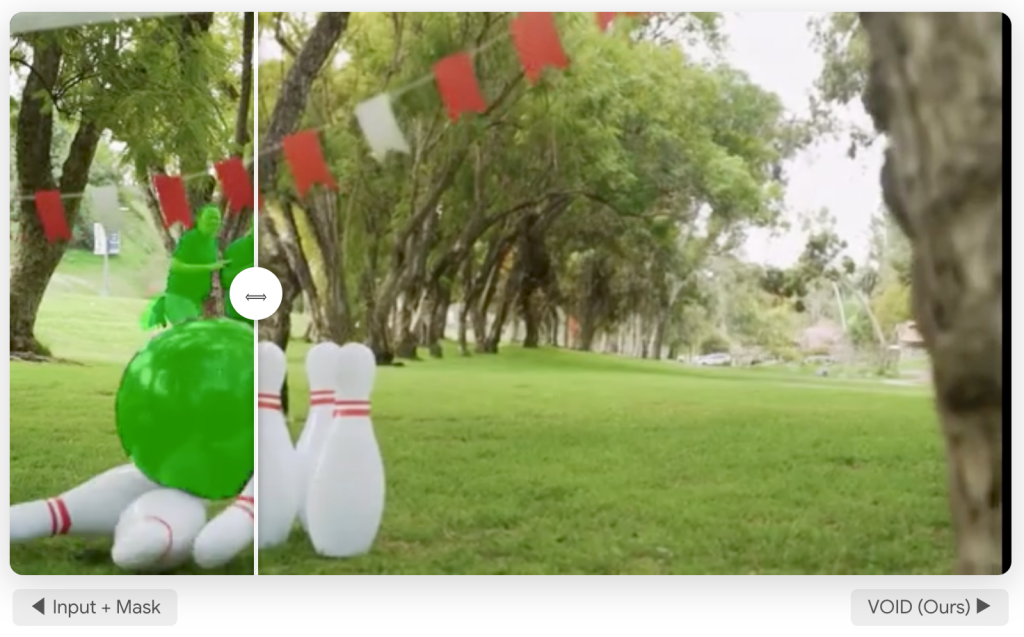
To be clear, the AI tool is not in production, is not an official Netflix product, only works on short clips, does not generate seamless video and – most importantly, for our purposes – is not designed for product placement. Its name is Video Object and Interaction Deletion, after all (emphasis mine).
But if the tool is able to remove an object and its effects from a clip, then it’s conceivable it could be reverse-engineered to insert an object and have it interact with objects already existing in the clip. And that’s what I want to talk about.
Virtual product placement in TV shows, movies and videos is not new. Companies like Mirriad are able to take old episodes of TV shows and insert brands. For example, they can swap out the signage in a background billboard from a decade-old scene to feature a movie currently in theaters. Or they can change the logo on a character’s T-shirt.
But that’s effectively like photoshopping a pimple from someone’s face. What VOID can do is akin to changing the person’s facial expression entirely and – because it’s video – capturing the expression changing.
The VOID version of virtual product placement could be changing the drink in someone’s hand from a generic soda can to a can of Red Bull with its distinct vertical silhouette, with the shape of the character’s grip and any shadows cast by the can changing as well. Or changing the car a character is driving from a nondescript sedan into a Rivian R2, with the scenery accurately reflecting on the car’s body and windows and casting accurate shadows back onto the scene. Or adding a Bladerunner-style holographic billboard that casts light onto the characters in a scene.
As the team behind VOID wrote in a research paper about the tool, “Void [sic] does not just recall simple visual cues from its training data, but applies high-level reasoning and world knowledge from the VLM [vision-language model] and underlying video diffusion model to video editing. As such, it is likely to benefit as more capable generative models become available.”
In other words, the AI tool can detect and understand the relationships between objects in a scene. That’s the groundbreaking part. VOID shows how AI video generation models can be used not to paint over existing video but to effectively alter the activity captured in the video. Which is all kinds of ominous when thinking about how it can be used for misinformation and disinformation, so let’s stick to the benign dystopia of branded content.
Actually, no. There’s no way to ignore the potential for this technology to be misused if and when it becomes generally available. VOID’s creators don’t touch on that in their research paper, but it’s hard not to read the following line without that in mind.
“Mastering this capability will benefit film visual effects and make advanced video editing accessible to non-experts,” they wrote.
As always, if you think it’s hard to distinguish between real and AI-generated videos today, just wait until tomorrow.
What we’ve heard
“There’s a reason we call it Beast Industries, not MrBeast Industries…I’m actively building up 10 more Jimmys.”
— Beast Industries CEO Jeff Housenbold
Numbers to know
13.1%: NBCUniversal’s and Versant’s combined share of TV watch time in February, thanks to the combination of Super Bowl, Winter Olympics, NBA All-Star Game and Nielsen’s updated methodology.
~1,000: How many employees Disney may reportedly end up laying off in the coming weeks.
$15.99: New monthly subscription price for YouTube’s YouTube Premium tier.
4.4%: Percentage share of eligible streaming programs that qualified for bonuses in 2025 for being viewed by 20% of a streamer’s U.S. subscribers within the first 90 days.
$321 million: How much money film-and-TV studios will contribute to the Writers Guild’s health fund.
~1.2 million: How many paid subscribers Mubi had at the end of 2025.
What we’ve covered
MrBeast is so big, Beast Industries turns down eight-figure brand deals if they aren’t the right fit:
- In the two years since Jeff Housenbold took over as CEO, the company built around YouTube’s most-watched creator has quietly flipped the commercial dynamic: Fortune 1000 CMOs are now calling them, not the other way around.
- What’s replaced the old model is a smaller book of longer, deeper partnerships — multi-year, category-exclusive, built around brand objectives that go well beyond a single video.
Read more about Beast Industries’ sales strategy here.
With the World Cup around the corner, media buyers expect streaming prices to soar:
- Scarce ad breaks – brands only have the pre and post-game, hydration breaks and half-time pauses in which to reach viewers – and the United States’ role as co-host have served to pump up pricing.
- Forecasts by performance advertising business Keynes, based on analysis of streaming CPMs during the 2024 Summer Olympics, and this year’s Winter games, suggested that CPMs for World Cup coverage would range between $60 and $120.
Read more about World Cup ad pricing here.
Creator scandals have turned morality clauses into brands’ go-to exit strategy:
- Baked into the boilerplate of most influencer and creator contracts, morality clauses required talent to maintain broadly defined behavioral standards or face termination.
- In practice, they hand brands near-unilateral power to walk away from partnerships — no court, no arbitration, no explanation required.
Read more about morality clauses in creator contracts here.
What buyers got out of the NewFronts and expect to happen in the upfronts:
- Ad buyers generally shrugged their shoulders about any standout content at this year’s NewFronts but commended the increased effort to shore up measurement across myriad platforms as a way to demonstrate effectiveness.
- The sens we’re getting as marketers go into the upfronts is a focus on flexibility and enhanced expectations of big media to be better integrated and provide better measurement and outcomes.
Read more about the NewFronts and upfronts here.
What we’re reading
The Justice Department is looking into whether the NFL is driving up costs for people to watch games as a result of the league signing more rights deals for smaller game packages, according to The Wall Street Journal.
Hollywood’s Paramount-WBD opposition:
More than 1,000 members of the entertainment industry signed a letter opposing Paramount’s planned acquisition of Warner Bros. Discovery by reducing competition among film-and-TV studios, according to The New York Times.
Wall Street’s streaming scrutiny:
As the latest quarterly earnings season gets under way, investors and analysts are looking for signs that companies’ streaming services are making up lost profits from shrinking traditional TV businesses, according to CNBC.
The Fox-owned free, ad-supported streamer has launched a ChatGPT app for people to get recommendations of what to watch via the AI chatbot, according to The Wall Street Journal.
The TV network owner has rebranded itself to deemphasize its TV network ownership and play up its growing streaming business, according to The Hollywood Reporter.


More in Future of TV

Future of TV Briefing: TikTok Shop success = small creators + more videos
This week’s Future of TV Briefing looks at how “more videos from smaller creators” is the recipe for success on TikTok Shop.
Future of TV Briefing: Hispanic TV-and-streaming viewership in 4 charts
This week’s Future of TV Briefing looks at how Hispanic audiences spend their time between traditional TV and streaming.

Future of TV Briefing: TV ad industry’s measurement currency frustrations hit (another) boiling point
This week’s Future of TV Briefing looks at a new task force being formed by the Coalition for Innovative Media Measurement to tackle the TV ad industry’s measurement currency conundrum.