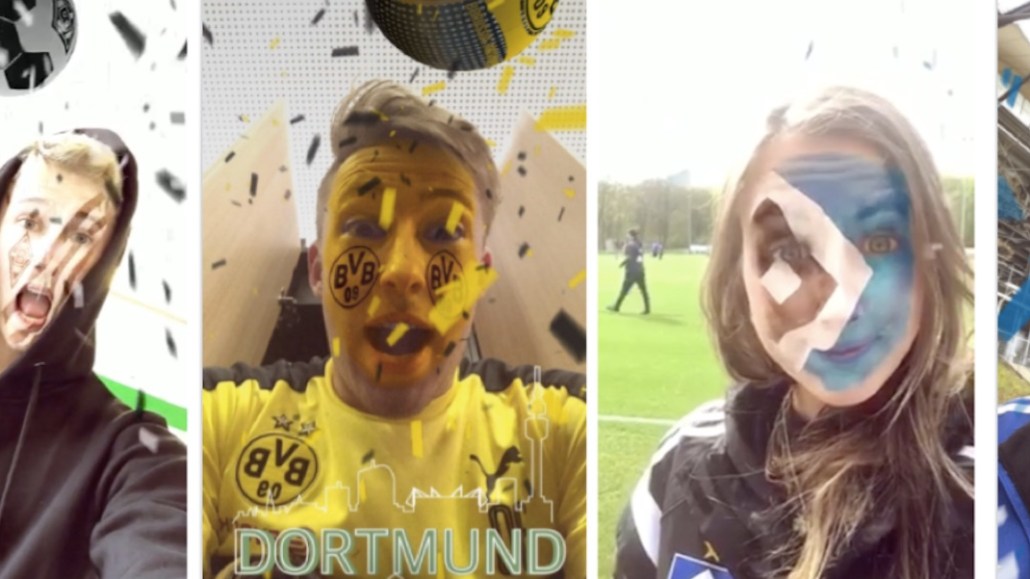
Snapchat is expanding its footprint in Germany this weekend with eight custom lenses for the top football clubs competing in Germany’s football league, the Bundesliga.
The eight teams — Hamburger SV, Borussia Mönchengladbach, SV Werder Bremen, Hertha BSC, FC Schalke 04, Bayer 04 Leverkusen, Borussia Dortmund and Bayern Munich — each have their own lens, which features the team’s badge and lets fans paint their faces in the team’s colors.
The lenses act as animated overlays and will be available to all Snapchat users in Germany this weekend. Afterward, they will be geotagged to each team stadium for the rest of the season, which finishes at the end of May. The season started at the beginning of August 2016, with 18 teams.
This weekend, most of the eight teams will also their own static overlay geofilters, so at games and nearby, fans can overlay team badges and logos to their snaps.
There are 53 million daily active Snapchat users in Europe (158 million globally), according to Snap, but it doesn’t separate figures for Germany. Over a third of global active users play with lenses each day, said a company rep.
In January, Snap created similar lenses for 10 football clubs in the Champions League, including teams from the U.K., Spain, Italy, and Borussia Dortmund and Bayern Munich from Germany. AS Monaco got its own lens this week for qualifying for the Champions League semifinal.
The lenses for Germany’s Bundesliga arrive just two weeks after Snap announced the launch of Snapchat Discover with German media outlets including Bild, Spiegel Online, Sky Sports and Vice.


More in Marketing

The official judgmental map of Cannes Lions 2026
This map won’t tell you where to go during Cannes Lions. It will tell you where you actually are.

The definitive Digiday guide to what’s in and out at Cannes 2026
Here’s what’s in and out for the Cannes Lions International Festival of Creativity.
As AI reshapes search, TikTok turns discovery into a performance pitch
The platform argues rising search activity is evidence that discovery is increasingly driving performance outcomes advertisers expect.