Secure your place at the Digiday Media Buying Summit in Nashville, March 2-4
Subscribe: iTunes | Google Play | Stitcher | Anchor
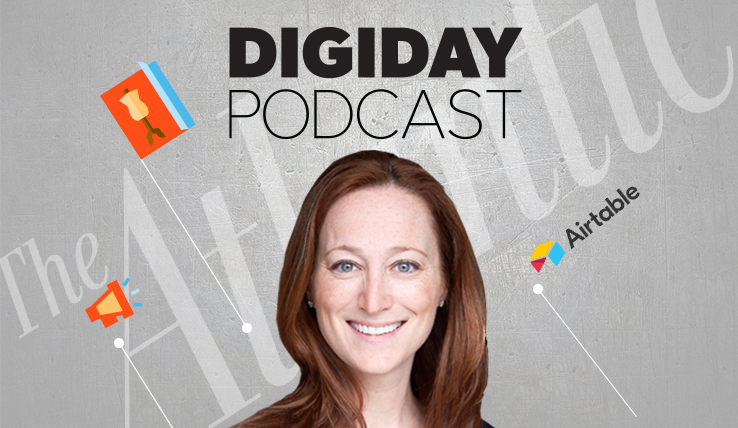
It’s been about nine months since Emerson Collective, a philanthropic organization founded by Laurene Powell Jobs, acquired a majority stake in The Atlantic. On this week’s Digiday Podcast, The Atlantic’s svp Hayley Romer talks about the publication’s ambitions in the wake of the acquisition, growing reader revenue and the challenges of advertising.
“There’s a lot of value that publishers provide that platforms can’t provide,” said Romer on the podcast. “[Advertisers] have efficiency challenges and targeting needs that platforms provide, but publishers are not necessarily in the same space. We’re a different business. Brand safety is a thing. You need to be in an environment that’s credible and understand the environment you’re in. We have a 90 percent renewal rate with our native advertisers.”
Edited highlights from the episode appear below:
The acquisition was not to save The Atlantic
“Emerson Collective saw the success we’ve had already and attributed it to our heritage and the fact that we’ve strategically built a business based of off our heritage. When [Jobs] acquired The Atlantic, the idea was not to save The Atlantic, and certainly not from itself. We’ve been growing the business from a print magazine to a digital powerhouse. We’ve done it in a way that’s profitable, and we’re maintaining our integrity. Legacy isn’t a dirty word. Probably 10 years ago, it was a bit of a dirty word. What we’re finding today is that legacy enables us to do so much more.”
Better user experience is the next goal
“We’ve got a foothold in trust and credibility with the audience. We’re looking to expand the brand from an editorial, product and business product. We’ll be authentic about who we are. You’re not going to see us suddenly bursting into the fashion scene. We’ve been at the forefront of innovation. How can we offer an incredible experience for readers technologically? What can we do to improve the ways people find us? We’re also looking for journalistic impact. Our initial ambition is to increase The Atlantic’s impact technologically. We’re adding to our product and engineering teams. We want to be faster, provide better experiences and express our journalism in more ways.”
Reader revenue is a priority
“The reader revenue is lower than our advertising portfolio. We’re growing the subscription product [The Masthead] more than our advertising product. Readers get access to the print magazine as a digital copy, to writers and editors, and some events. Any brand has different levels of value to different people at different times. It’s incumbent upon publishers to figure out how you provide different levels of value to people. The metered system provides a different level of value for somebody who will come to The Atlantic 10 times a month and not every day. I don’t think there is a downside to the metered model — you just need to provide the right experience.”
Direct advertising remains important
“There’s no question that we’re not sure where the future lies in terms of the advertising industry continuing to go toward publishers instead of taking advantage of the duopoly. But direct advertising is still an important part of our strategy because it’s still growing for us. [In March,] we had the largest advertising booking revenue month in the history of The Atlantic.”


More in Media

Media Briefing: Turning scraped content into paid assets — Amazon and Microsoft build AI marketplaces
Amazon plans an AI content marketplace to join Microsoft’s efforts and pay publishers — but it relies on AI com stop scraping for free.

Overheard at the Digiday AI Marketing Strategies event
Marketers, brands, and tech companies chat in-person at Digiday’s AI Marketing Strategies event about internal friction, how best to use AI tools, and more.

Digiday+ Research: Dow Jones, Business Insider and other publishers on AI-driven search
This report explores how publishers are navigating search as AI reshapes how people access information and how publishers monetize content.