Join us Sept. 24 in NYC to connect with execs from Digitas, Claire's, Marriott, Havas and others
Nowhere is safe: Fortune cookies now have ads, starting with Capital One
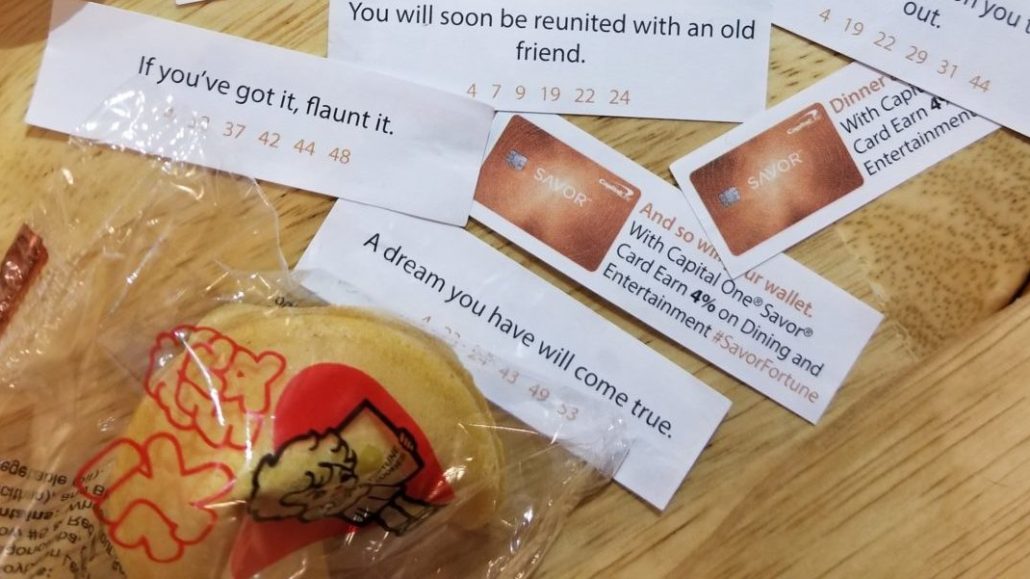
If Shawn Porat realizes his dream, every fortune cookie will have an ad inside of it.
The startup founder of OpenFortune — he goes by “chief fortune officer” — has spent the last eight years building a business — much of which involved logistics within the supply chain of cookie factories and Chinese restaurants — to place ads on those tiny paper slips. On Aug. 19, Porat had one of his first big breaks when BuzzFeed’s Ben Kaufman tweeted to his nearly 12,000 followers about one of those ads, featuring Capital One:
Ad blockers ain’t got nothing on the nyc take out market. pic.twitter.com/Q6WUnu5qTX
— Ben Kaufman (@benkaufman) August 19, 2018
Capital One has bought promotions in 10 million fortune cookies to be distributed across about 5,000 Chinese restaurants in the U.S. Porat’s company, OpenFortune, has sold half of its 2019 monthly campaigns, he said. Porat declined to share names due to non-disclosure agreements but said upcoming campaigns include CPG, dating, auto manufacturers, wireless, financial services, tech and travel companies.
To some media buyers, fortune cookie ads may be creative and underutilized or expensive and potentially untrackable. Porat and his counterpart Matt Williams, chief cookie officer of OpenFortune, said those brands don’t have to get onboard. As for ROI, they’re hoping to prove its value through promotions written on the fortunes and social media posts. Beyond Kaufman’s viral tweet, there are more than 1.2 million posts on Instagram with the hashtag #fortunecookie.
“The emotions we value are prosperity, compassion, growth and luck. We always work to maintain the integrity [of the cookie]. We keep the lucky numbers, keep the fortune and work with brands to drive emotion. We won’t pitch a brand that we feel like is a stretch,” Williams said.
The idea for selling ads in fortune cookies came to Porat in 2010, unsurprisingly, when he was dining at a Chinese restaurant, specifically China Kettle in Brooklyn. Brands weren’t interested in ads in Chinese restaurants at the time, but they were curious about branded fortune cookies. Porat worked with TJ Maxx, Salesforce and Bloomingdales on promotional cookies, he said. In 2014, he worked with the Missouri Lottery for a version of his original concept.
OpenFortune, previously Fortune Cookie Advertising, has since embraced that original idea of ads in cookies and distributed through Chinese restaurants. They work with about 50 percent of the 44,000 Chinese restaurants in the U.S., which took a lot of phone calls.
“It should have been a reality TV show, calling restaurants and they’re like, ‘Hi, what’s your order?’ and me saying, ‘Hi, I’m giving you free cookies,’” Porat said.
As for making the ads and the cookies, OpenFortune works with printers in Florida, North California and California. They use soy-based ink, so the cookies stay edible. They print in multi-colors rather than the typical black font on white paper. The wrappers and cookies are made in Chicago and New York.
Now, with years of experience and the logistics understood, it costs about 10 cents to produce every cookie. That cost decreases based on volume and other variables, going as low as a penny for nationwide campaigns.
Part of the ROI and tracking mimics subway ads and other out-of-home advertising for some brands. Williams said they can use the lucky numbers as something to enter on a brand’s website to potentially win something. They hope to “gamify” the experience, taking cues from McDonald’s Monopoly game.
“This is our dream: You’re never going to get a cookie without an ad,” Porat said.


More in Marketing

Future of Marketing Briefing: Creators are learning to pitch AEO, not just audiences
The next line in a creator’s pitch: I got cited

Should brands swerve, or steer as F1’s U.S. viewership adapts to new coverage?
Formula One is spending to re-engage fans for the seasons’ second half. With viewership figures under question, should brands seeking to share its growth story worry?

Inside the complex anatomy of agency AI bills
From AI subscriptions to metered token usage, agencies are grappling with a more complicated cost structure and who pays.