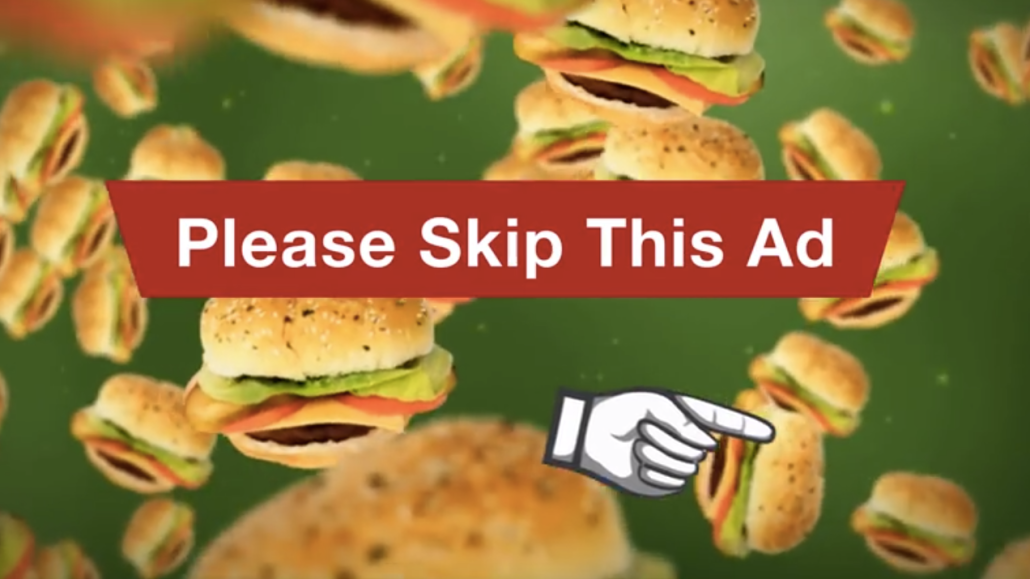
Eat24, the food delivery app, has figured out how to get people to watch YouTube pre-roll ads. The secret? Tell them not to. In a recent campaign, the app literally told viewers to “Skip This Ad,” — and Jedi mind tricked them into watching. Here’s Eat24’s rationalization:
“In all likelihood, most viewers would pre-position their cursor over the ‘Skip Ad’ button, ready to blast away our commercial ASAP. And who could blame them?”
But the reverse psychology approach seems to have struck a nerve, as they explained in a blog post about the experiment.
The video has more than 581,000 views on YouTube …
… and saw a 75 percent increase in app downloads the weeks the campaign was running. More than 90 percent of viewers actually completed watching the ad, which had a staggeringly high click-through rate of 7.1 percent.
It’s not the first time a brand was clever about their preroll placement. Last year Volkswagen had a similar gimmick in its Beetle campaign. The car, the ad said, “automatically shifts gears and skips ads for you.”
Nor is it the first time Eat24, which has been known to place display ads on porn sites, has itself dabbled in unorthodox advertising. But the cutesy approach appears to have had a real impact. While Eat24 had to pay for each of those “Skip This Ad” views, it claims it resulted in “thousands more orders from new customers.”


More in Marketing

‘The processes are continuing forward’: Advertising’s dealmakers press on with M&A despite Iran uncertainty
War in the Middle East is a problem for advertising’s dealmakers. Just not yet.

In graphic detail: The numbers making the case for what holdcos could be
What the data says about the CMO-agency relationship — and none of it is comfortable.

TikTok rebrands its advertiser pitch around full-funnel ambition
The company’s latest business campaign aims to make the point that the app sees itself as a top tier platform for advertisers, where the full funnel can happen within one experience.