
The Wall Street Journal has become the latest big-name publisher to ask people to turn off their ad blockers. Visitors to the financial news publisher’s site are being greeted with a polite message asking them to turn off their ad blockers and to subscribe to the publication.

A rep for the Journal said it’s showing the messages to some WSJ.com readers in the U.S. and Europe who have installed ad blockers. It doesn’t block the Journal’s free-access articles.
The move is interesting since the Journal is blocking articles that already require a subscription, making the case that not only should readers pay $200 a year for access but also take the ads (and tracking) that comes with the package. In the Journal’s case, the messages don’t appear to people unless they’re not logged in, though, either as a subscriber or through social media, which would seem to minimize that risk. It’s not known if the Journal plans to up the ante and prevent ad blockers from reading the site altogether.
The WSJ is testing a few versions of the messages. In one, the message appears as a banner across the bottom of the page.
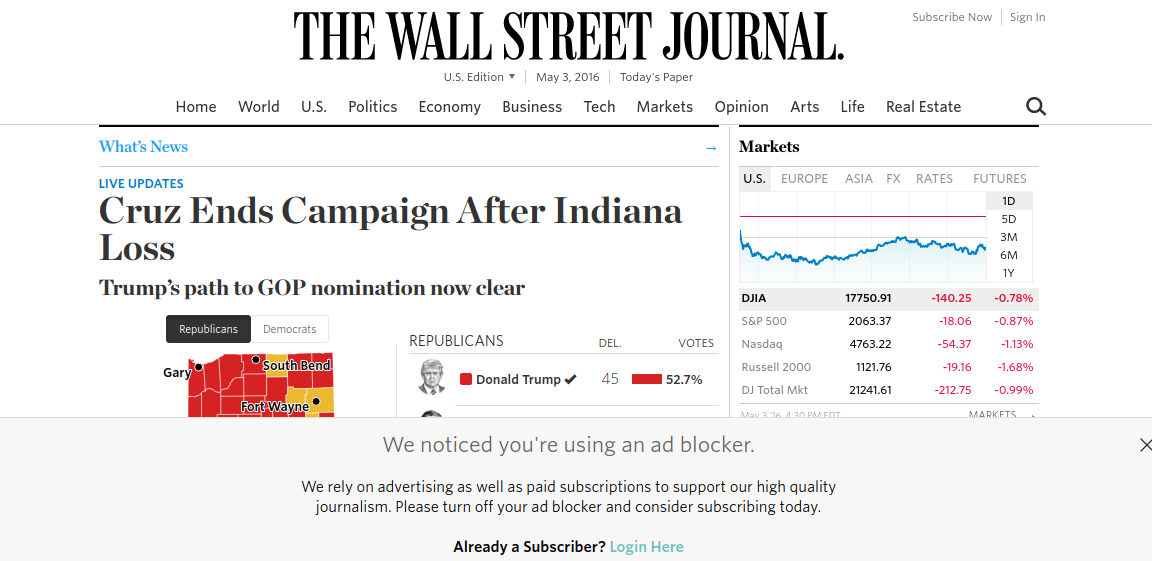
The Journal message is similar to one the The New York Times just began testing in March to combat ad blocking. A number of other publishers have asked readers, with varying degrees of forcefulness, to turn off their ad blockers. They’re alarmed by the rapid adoption of ad blocking software that reduces the number of eyeballs they can sell advertising against.
The tactics have been met with varying degrees of success, and there’s no agreement on what the right approach is; some say the hard line only escalates bad feelings with readers, who understandably are using ad blockers to avoid seeing annoying and intrusive ads. Others say the soft approach doesn’t work because it can be a hassle for readers to disable their ad blocking software (some of whom may not even know it’s installed in the first place).
The Journal has been clamping down on freeloaders in other ways recently. In January, it tested closing the Google loophole that let people copy and paste a Journal article link into Google to circumvent the Journal’s paywall.


More in Media

SPUR publishes AI content tracking standard, pitches OpenAI and Google to join advisory board
Publishers are pushing for AI transparency with a new SPUR standard to track how AI tools use content, and inviting frontier AI labs to help.

Media Briefing: Publishers are turning GEO from an experiment into a business
Publishers are turning GEO into a new revenue stream as clients increasingly look to boost their brands’ visibility in AI-generated answers.

The creator economy’s stance on AI is shifting — again
Creators are integrating AI tools into their workflows, but at what point does it overtake the creative process and result in sameness?