Thrillist isn’t the first publisher to build out a content studio — everyone from The New York Times to Vice has spun one out — but Thrillist sees an opportunity to differentiate with a hardcore data focus that comes naturally to a publisher that’s also a retailer.
For Thrillist’s 16-person brand content team, called The CoLab, that means using months-long brand health studies and benchmarking campaign performance against competitors.
“[It] stemmed from a desire to validate everything we say about our branded efforts,” said Paul Josephsen, vp of The CoLab. “If you tell a client their campaign saw 35 percent brand lift, they’ll say, ‘Cool.’ But if you tell them it performed in the 90th percentile of their entire category, then you’re really getting somewhere.”
TMG has relied heavily on its internal research capabilities, led by research manager Bobby LaCivita, to provide this information to its advertisers. LaCivita and his team have developed dozens of best practices. Their findings range from quantitative editorial insights (include 30 brand-terms per article to drive maximum purchase intent) to design guidelines (the strongest banner ads contain 30 percent direct branding). LaCivita then relays this information to the creative teams, which generate content and optimize based on the findings.
“At The CoLab, we really understand that not all content is built the same,” said LaCivita. “So we use science to give direction to our creative processes.”
One major result of LaCivita’s research is the TMG Branding Cell, which helps writers brainstorm a range of terms — both heavily branded and loosely branded — which are then used to guide the process of content creation. This BuzzFeed-style article about Texas, for example, was written for Lone Star Beer with guidance from the branding cell below. The article includes terms from each of the three critical tiers: direct branding, product category mentions and main-theme terms.
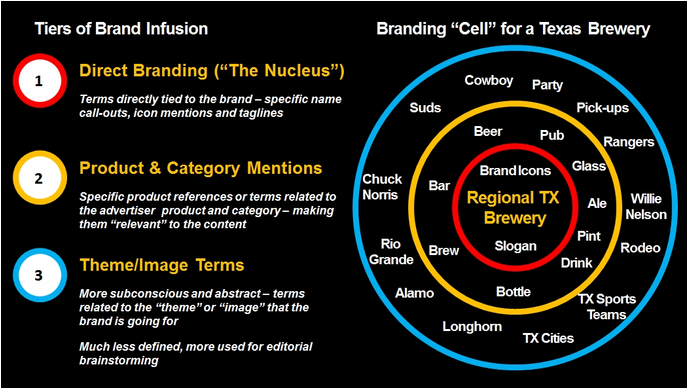
“As an editor, the Branding Cell has given me a completely new way to look at my work,” said Hayden Lynch, senior director of creative strategy at The CoLab. “It challenges us and holds my team accountable for the success of our work. What it really does is take the guessing out of creativity.” Meaning, they have a pretty good idea of how each piece of content will perform before it’s even published.
For Thrillist, the data capabilities are a way to differentiate in a crowded market.
“They’ve been so smart about how they’re packaging this CoLab offering,” said Sam Olstein, the global director of innovation at General Electric and a longtime TMG client. “The collaboration between their creative and research teams, and the learnings and insights they provide, is exceptional. I can’t wait to see what they do for us next.”


More in Media

After an oversaturation of AI-generated content, creators’ authenticity and ‘messiness’ are in high demand
Content creators and brand marketing specialists on how 2026 will be the year creator authenticity becomes even more crucial in the face of rampant AI-generated “slop” flooding social media platforms.

‘The net is tightening’ on AI scraping: Annotated Q&A with Financial Times’ head of global public policy and platform strategy
Matt Rogerson, FT’s director of global public policy and platform strategy, believes 2026 will bring a kind of reset as big tech companies alter their stance on AI licensing to avoid future legal risk.
Future starts to sharpen its AI search visibility playbook
Future is boosting AI search citations and mentions with a tool called Future Optic, and offering the product to branded content clients.