Community auto site Car Throttle breaks programmatic ground, eyes US expansion

U.K. news and bulletin board Car Throttle, “the Internet’s car community,” is betting big on original video.
Editorially, the site publishes mostly to Facebook, YouTube and Snapchat, where on big filming days it can push out up to 30 Snapchat Stories, to the tune of millions of views. In October, its editorial videos gained 147 million views across YouTube and Facebook, according to video analytics firm Tubular labs. By comparison, wrestling channel WWE, which ranked seventh in October as the most watched video creator, had just over 511 million views.
“I want our users to have a voice, create content and create a following,” said Ebrahim, “I want Car Throttle to be able to create a new generation of automotive influencers.” The platform is a mix of editorial content, original video and posts uploaded by users, which make up 99 percent of the site, according to Ebrahim.
Up until last week, the site made all its revenue from branded content like this tie-up with Xbox, “2 Guys 1 Car Battling the Stig at the Top Gear Test Track,” which has nearly 2 million YouTube views. Those numbers don’t exactly break the counter, but the video performs well against Xbox’s target of 50,000, with most viewers watching for over half the video.
It’s now one week into running a programmatic native ad campaign for gaming brand Electronic Arts (EA). The EA campaign is also the first programmatic native campaign to run in Europe bought on a private marketplace, as opposed to an open ad exchange.
“The U.S. is more advanced than the U.K. in terms of spend and advertiser adoption, due to a bigger market, also native programmatic platforms are mostly U.S. companies,” said Ebrahim. Until now, the technology hasn’t been available in Europe to carry out these deals on private marketplaces.
At time of writing, the EA campaign was seeing a click-through rate of 1 percent, which surpasses the lifestyle vertical average of 0.3 percent measured by native ad platform Polar.
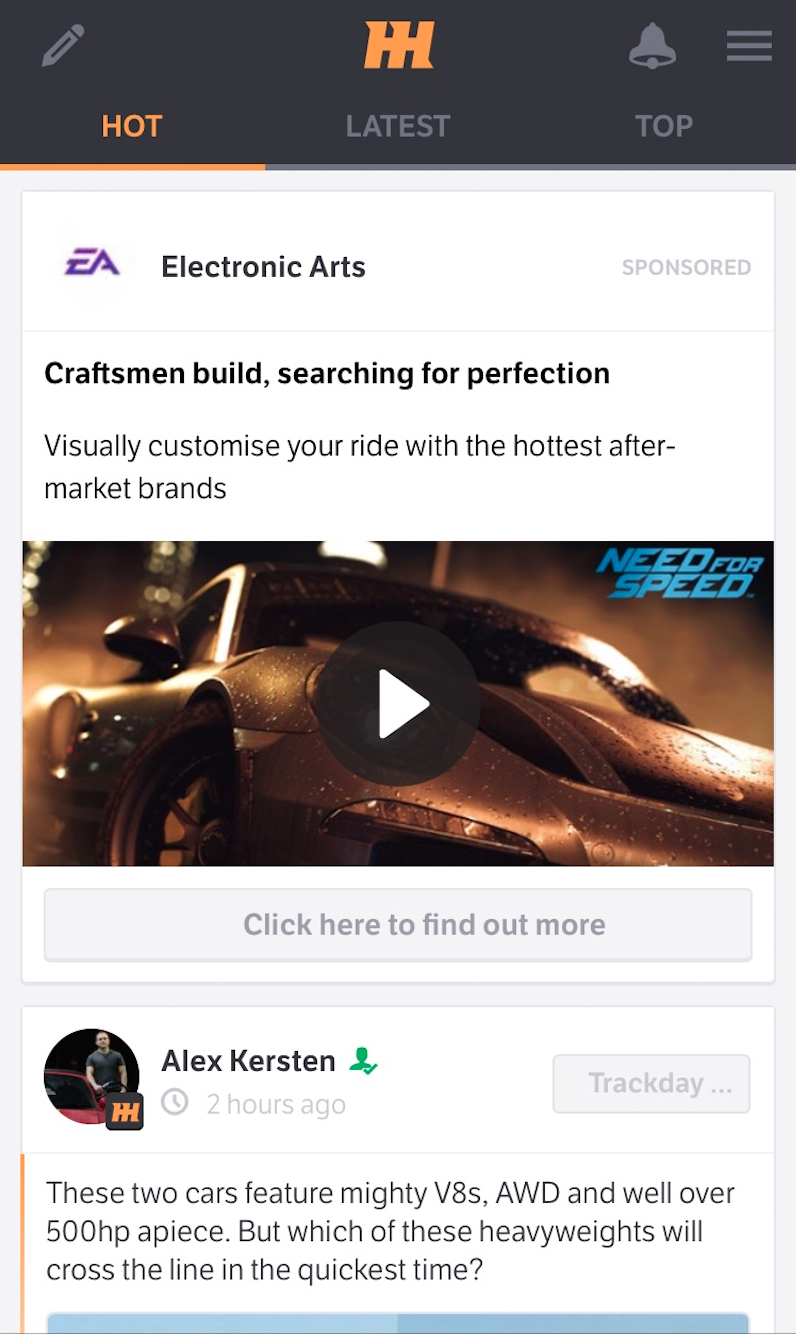
More private marketplaces for native ads are expected as more publishers opt for the efficiency and efficacy of programmatic. Mark Syal, managing director and head of media planning at Essence, points out that trading privately means buyers will secure their preferred inventory and sellers will fetch a higher yield.
“Buying over private marketplaces gives the buyer transparency, and if you’re concerned about safe environments, then seeing how the work performs in controlled setting will be a good experiment,” he said.
However, there is a warning in this growth. “Native programmatic on open exchanges is already much more common than it was six months ago. As the supply of native increases, so will supply in programmatic.
“Currently consumers don’t seem to mind native ads, but the more widespread it becomes, as soon as they start seeing the same native placement across different sites, then it becomes irrelevant. As it becomes ubiquitous, it will begin to lose that value.”
For now, Car Throttle is going where its audience is, launching a New York hub this week to manage sales in the region. It’s a no-brainer, considering most (35 percent) of its traffic comes from the U.S., according to Ebrahim. “We’re going to take advantage of the revenue opportunity where we have the most impressions.”


More in Media

Creator mentors Colin and Samir want to turn their followers’ ideas into productions
Creator mentors Colin and Samir teamed up with Adobe to fund a creator’s project; the first step towards the duo’s new production era.

How a fashion creator turned audience demand into a 500+ client styling business
A creator with a fashion merchandising degree speaks on her quest to diversify revenue fast, from styling to sweat equity investment.

Forbes looks to Google AI pilot for insights as publishers seek value beyond the click
Forbes has joined Google’s paid News AI pilot that gives Google expanded rights to its content to test new ways of providing readers with context about stories before they click through.