When The New York Times’ Innovation Report called for the paper to find new uses for its expensive editorial content, this probably wasn’t what its authors had in mind.
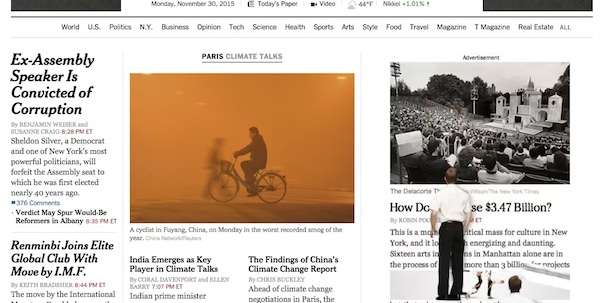
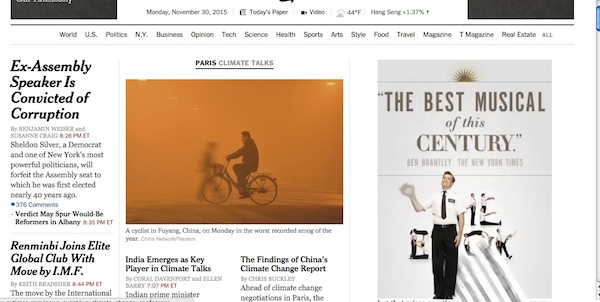
An animated ad for the Broadway hit “Book of Mormon” on the paper’s homepage Nov. 30 featured an October article from the paper’s arts section.
Although the ad was labeled “advertisement,” it’s designed to look like a bona fide editorial article, with Times-style font and design. Until, that is, characters from the show jump out of the photo and strip away the article to reveal a banner ad for the show.
The Times has featured its articles in ads before, including a recent campaign for Google that contained repurposed travel articles. But this is believed to be a Times first: an ad that includes a screenshot of an actual news article, according to a Times spokeswoman.
“We have featured portions of Times articles in print ads before and we have featured links to Times articles in digital ads before,” she said. “However, we believe that this is the first digital ad that features a screenshot of a portion of a Times article.”
Advertisers and publishers have been working more closely together on so-called native ads that are designed and written in the style of the host publication. But the editorial side is usually kept out of the process so as to preserve its independence.
But native ads are very often obviously ads, and as such are ignored by readers. The appeal of having real articles in ads is that it can lend credibility to the advertiser. The Times permits articles to appear in ads as long as it’s labeled “advertisement,” there are no contractual limitations with individual reporters and the article is at least a week old, the Times rep said. The “Mormon” ad was approved by the ad acceptability department and the newsroom’s standards editor.
The risk is in putting off readers if they think the article was written for the benefit of the advertiser. The possibility of the “Mormon” ad causing confusion would seem limited, though, as the original article ran almost two months ago and it’s not a review for the show but a story about arts fundraising. As with other cases where Times articles are used in ads, the arts article serves more as a backdrop or prop and isn’t meant to be read in its entirety. The ad ends with a typical banner image containing a quote from the Times’ Ben Brantley praising the show.
The practice of using editorial articles in ads raises several questions, said Kelly McBride, who teaches ethics at the Poynter Institute. On the one hand, publishers should permit the practice because it contributes to an open marketplace of idea. The risk is that the edit will be distorted, though, and that when consumers see this, they question the publisher’s independence, she said.
Twitter had mixed reactions to the ad:
Not a big ad fan, but front pager on NYT for “Book of Mormon” is amazing … https://t.co/L0T1bYiT27 …
— Capitol Weekly (@Capitol_Weekly) November 30, 2015
https://t.co/mAdiQmx6s2 Loved the Book of Mormon Banner… great creative!
— Nicolas Visiers (@visiers) November 30, 2015
Super weird ad on https://t.co/RzRXhXQh6i front right now. Overlaid on an actual NYT story is a Book of Mormon ad. Clicks on story redirect
— Matt Clarida (@MattClarida) November 30, 2015


More in Media

SPUR publishes AI content tracking standard, pitches OpenAI and Google to join advisory board
Publishers are pushing for AI transparency with a new SPUR standard to track how AI tools use content, and inviting frontier AI labs to help.

Media Briefing: Publishers are turning GEO from an experiment into a business
Publishers are turning GEO into a new revenue stream as clients increasingly look to boost their brands’ visibility in AI-generated answers.

The creator economy’s stance on AI is shifting — again
Creators are integrating AI tools into their workflows, but at what point does it overtake the creative process and result in sameness?