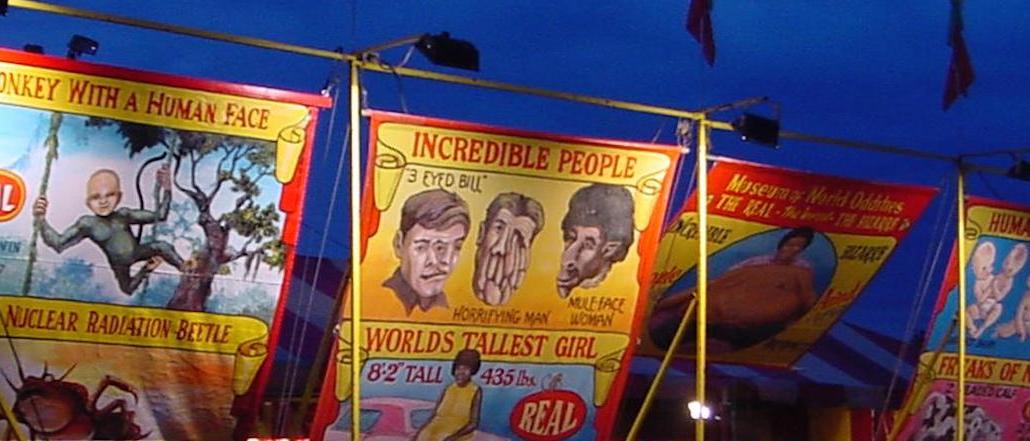
It isn’t the first time Donald Trump has been called a sideshow.
On Friday, the Huffington Post cited the presidential candidate’s exhibitionist behavior as reason enough to move all coverage of his campaign to its Entertainment section. Washington bureau chief Ryan Grim and editorial director Danny Shea made the announcement in a note, writing: “If you are interested in what The Donald has to say, you’ll find it next to our stories on the Kardashians and The Bachelorette.”
It’s a strong stance for a news outlet to banish the coverage of a candidate who is leading polls for the Republican nomination — Trump secured 17 percent support in a Suffolk University/USA Today survey released this week. Former Florida Gov. Jeb Bush garnered 14 percent.
Some observers wondered whether it was the Huffington Post’s call to make. Others merely questioned the website’s definition of “entertainment.”
Either way, it’s being met with mixed reactions from the media community, which, naturally, aired its opinions on Twitter:
Brilliant decision by the Huffington Post. https://t.co/EA0jkOkp8s pic.twitter.com/EnVKQ1rA5i
— Jay Rosen (@jayrosen_nyu) July 17, 2015
It is not up to The Huffington Post or any other publication to decide which candidates are legitimate. That’s not how this works.
— Olivia Nuzzi (@Olivianuzzi) July 17, 2015
HuffPo moving Trump to the Entertainment section is also–seriously–an insult to Entertainment, which shouldn’t just be “the dumb news.” — James Poniewozik (@poniewozik) July 17, 2015
HuffPo thinks it’s marginalizing Trump when it’s only marginalizing itself. — Jack Shafer (@jackshafer) July 17, 2015
HuffPo covers Trump “campaign” as entertainment, not politics: A statement and a truth. https://t.co/K77m1VEn8S
— Jeff Jarvis (@jeffjarvis) July 17, 2015
What’s the over/under on how long before @realDonaldTrump‘s name shows up in HuffPo’s politics section? 72 hours? 48? 24?
— Nick Martin (@nickmartin) July 17, 2015


More in Media
The Rundown: AI clones split the creator economy
Unauthorized AI voice clones and authorized digital twins are splitting the creator economy in half as brands, lawyers, and talent take stock.

The World Cup is a big chance for retail media to prove itself to advertisers
The World Cup, being much longer than other sporting events with more opportunities for campaigns, will likely serve as a case study for future retail media activations.

AI ‘girlfriend ads’ are fueling a new wave of MFA sites
AI-generated “girlfriend ads” are driving traffic to made-for-advertising sites filled with low-quality content and ads.