Join us Dec. 1-3 in Nashville for the Digiday Programmatic Marketing Summit

The search-optimization era was defined by the number of publishers that wrote stories in cynical traffic ploys on subjects like what time the Super Bowl starts. Now that we’re in the social age, however, the tactic of choice is the linkbait headline.
Pioneered by BuzzFeed, and possibly perfected by Upworthy, clickbait is a modern-day media scourge, as unbecoming as it is irresistible. Many of us lament it, still more can’t resist its siren call.
For the trio behind social startup CentUp, clickbait headlines have simply gone too far, to the point where they are a parody of themselves. To prove the point, they’ve created Headlines Against Humanity, a simple site that invites you, dear reader, to guess which of these headlines is real.
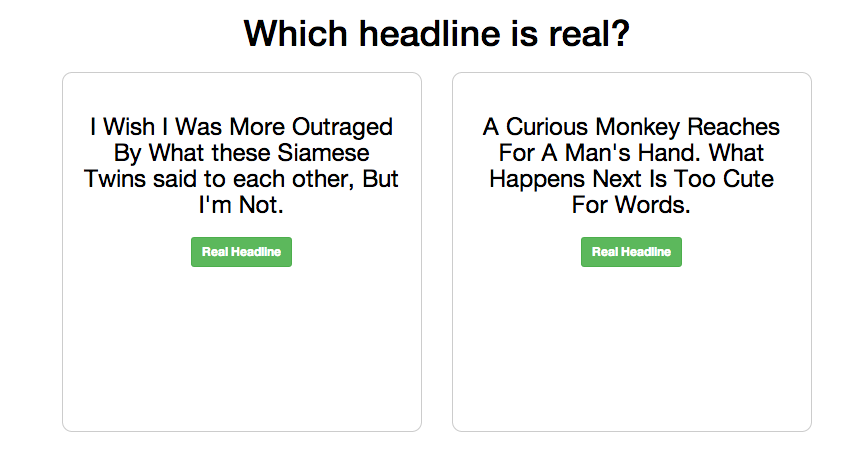
OK, how about these two?

(You’ll have to visit Headlines Against Humanity for the answers.)
Tyler Travitz, who created Headlines Against Humanity with fellow CentUp co-founders Len Kendall and John Geletka, explained to Digiday the rationale behind the site.
What’s your beef with clickbait? It wouldn’t exist if people didn’t respond.
It’s not a “beef” per se. It’s a commentary on the state of journalism. The current primary business models focus on advertising and that incentivizes publishers to focus on clicks because that’s what brings in the dollars. (As opposed to say catering to subscribers who care more about the quality of content). This isn’t new. What is new is the trend toward sensational headlines just to get people to view the page. We find this trend a bit unsettling because most times, the bite isn’t as good as the bait, thus your time is wasted.
Is social media making it worse?
Social media can often fuel narcissism. Sometimes it’s in the form of selfies but sometimes it’s through finding shareable content and getting lots of likes and shares. Lots of publishers have discovered that all they need is a create sticky headlines that give people social ammunition, regardless of whether that content is actually educational/relevant/accurate.
Won’t its effectiveness as a tactic inevitably decline? We’ve been down this road with other optimization tactics.
Headlines Against Humanity isn’t the first parody of this tactic so clearly people are starting to connect the dots. People in the media industry definitely are aware of this very methodical approach to headlines, but the masses still are sharing more of these links than ever. As more sites try to copy this tactic, it will likely lead to reduced effectiveness.
What’s the one headline that you remember hating the most?
His First 4 Sentences Are Interesting. The 5th Blew My Mind. And Made Me A Little Sick.


More in Media
The Hill adds interactive election tools to subscription offering ahead of the midterms
The Hill is betting on interactive subscriber-only features to help grow its new subscription business ahead of the 2026 midterms.
The Daily Mail tests GEO with brands ahead of AI visibility product
The Daily Mail is running around a dozen GEO tests to work out what works before turning its AI visibility offering into an official product early next year.

Meta delays rollout of updated commercial terms amid publishers’ collective pushback
Meta’s updated commercial terms have galvanized publishers into a coordinated pushback over the company’s use of their content.