Join us Dec. 1-3 in Nashville for the Digiday Programmatic Marketing Summit
Ad Tech Briefing: AI is reinforcing Big Tech’s grip on advertising growth

This Ad Tech Briefing covers the latest in ad tech and platforms for Digiday+ members and is distributed over email every Tuesday at 10 a.m. ET. More from the series →
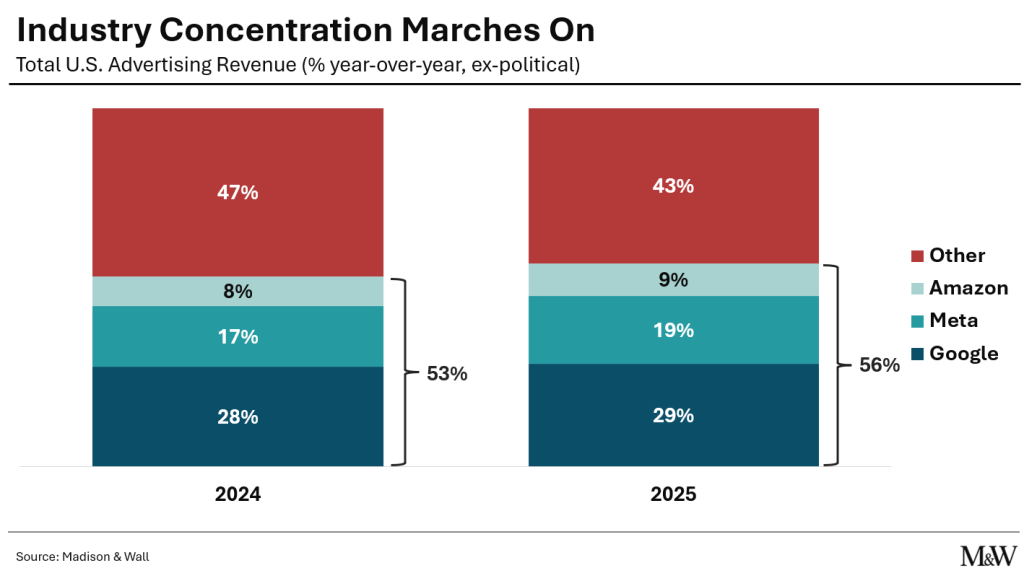
Google, Meta and Amazon already capture 56% of U.S. advertising revenue, with the continued migration toward automated campaign tools threatening to concentrate an even greater share of growth among the largest platforms.
The advertising market is expanding faster than previously anticipated. But the increasingly important question for the rest of the industry is not simply how quickly the market grows — it is who captures that incremental spending.
Disproportionate growth
Madison & Wall’s latest estimates point toward further concentration around Alphabet’s Google, Meta and Amazon. The research firm estimates the three companies accounted for 56% of U.S. advertising revenue in 2025, excluding political advertising, up from 53% in 2024. Google increased its share from 28% to 29%, Meta from 17% to 19%, and Amazon from 8% to 9%, while everyone else’s combined share fell from 47% to 43%.
That shift is particularly striking because it means the largest platforms are not merely participating in industry growth; they are capturing a disproportionate amount of it.
The trend coincides with another structural change highlighted by Madison & Wall: more advertising dollars are being directed through automated campaign products operated by the platforms themselves. Its estimates put AI-directed or automated spending at roughly 12% of the U.S. market, versus just 2% in 2023, with that share projected to reach 27% by 2030.
Google’s Performance Max and AI Max and Meta’s Advantage+ illustrate the dynamic. Rather than advertisers independently selecting inventory, audiences and bids, such products increasingly ask them to provide objectives and assets while platform algorithms determine how budgets are deployed – a lot of blind faith is required.
That raises an important question for marketers: what metrics and safeguards are sufficient to demonstrate that these systems are producing genuine incremental value rather than simply making platform-reported performance easier to achieve? Procurement pressure arguably makes that distinction more important as automated products become a larger component of media budgets.
Sustained outperformance
It also potentially strengthens the economic advantages already enjoyed by the largest platforms. More advertiser spending produces more data and opportunities to optimize automated systems, while better-performing automation can attract still more spending — reinforcing the scale advantages of businesses already controlling enormous pools of consumer data and inventory.
Madison & Wall’s Luke Stillman, speaking with Digiday in August, anticipated that trajectory. “We say in the U.S., it’s 56% of the total is the big three now. It’s going to be a little higher this year [2026]. We think it’ll be a little higher every year for the next five because they’re just going to outperform the average every year,” he said.
The implication extends beyond Google and Meta’s existing businesses. AI search environments represent another potential redistribution point. If advertising around products such as ChatGPT and AI-generated search becomes a major channel, the question is whether it creates meaningful competition for incumbent platforms or ultimately reproduces the economics that produced today’s concentration.
For now, advertiser behavior provides relatively little evidence of an impending reversal. Despite years of controversies surrounding the largest technology companies — ranging from privacy and brand-safety concerns to antitrust cases — performance and scale continue to outweigh many marketers’ reservations.

“We really think there’s only three ways that we break this cycle of. It’s certainly not going to be advertiser choice that does anything because no one’s willing to make that choice,” Stillman told Digiday in the earlier conversation.
Those three potential disruptions are significant changes in consumer behavior, a new hardware or computing platform capable of altering how people access digital services, or regulation sufficiently consequential to change the economics of the market.
Absent one of those interventions, Madison & Wall’s numbers suggest AI may be less a competitive reset for advertising than another mechanism through which its largest incumbents extend their lead.
Numbers to know
Numbers from the latest IAB ad spend report:
- 12.3%: IAB’s forecast for U.S. ad spending growth in 2026, revised up from 9.5%
- 16.5%: Expected growth in U.S. social media ad spending
- 15.6%: Projected increase in connected TV advertising spend
- 13.6%: Forecast growth in commerce media advertising spend
What we’ve covered
Amazon Ads brings advertisers to ChatGPT, extending its supply-chasing streak
Advertisers using Amazon’s DSP can now purchase ChatGPT ad inventory starting today, expanding Amazon’s external premium supply partnerships beyond Netflix and sports streaming.
Google rolls out pay-per-value AI licensing program to publishers
The tech giant, which has steered clear of the large lump-sum licensing deals struck between other AI rivals like OpenAI and major news publishers, has been quietly testing a Search Console-based program that pays publishers when their content “significantly” contributes to AI-generated responses across Gemini, AI Overviews and AI mode.
What we heard
“They were really fat. Beautiful offices, lots of assistants doing random things, an OS for television.”
– An unnamed source surmises on the rational behind The Trade Desk’s latest 15% cutbacks in headcount.
What we’re reading
LG smart TVs caught logging audio with screen off and snooping on local devices
LG smart TVs continuously sweep home networks, map secondary devices, and log microphone audio while appearing to be turned off, according to a new 135-minute-long video published by Gamers Nexus
Catching the ad tech M&A zeitgeist
First Party Capital examines how propaganda and clever positioning can play a pivotal role in the sales process.
Ad tech whammy
A hot take on the Google antitrust ruling, where the GAM-owner escaped a forced sell-off of its assets, this time from Gareth Hates Ad Tech.
Why Wall Street turned against The Trade Desk
AdExchanger analyzes how the tides shifted from the high watermark of December 2024 for the industry’s leading independent demand-side platform as it is slated to be removed from the S&P 500 on Sept. 21 and bumped to the S&P SmallCap 600 instead.


More in Media Buying

Omnicom lands Coca-Cola’s North American media business, as WPP retains its global remit
The beverage giant’s US and Canada media move to Omnicom as the holdco’s CEO John Wren made the case it would build a bespoke team, not a Pepsico holdover.

Omnicom said its integration of IPG is nearly done, and the results are starting to show it
As organic revenue grows and margins increase, Omnicom CEO John Wren said the fruits of the effort to buy IPG are starting to pay off.

Media buyers chart path for brands and sponsors through high NBA demand
Brands looking to push more dollars towards NBA audiences must choose between spending on a sponsorship, or funnel budget into TV, streaming and social.