Join us Dec. 1-3 in Nashville for the Digiday Programmatic Marketing Summit

The old saw is that millennials may spend a lot of time-consuming media, but they’re far less likely to spend money on it.
But the latest forecasts complicating that narrative that millennials are media cheapskates loath to open up their wallets for content. Millennials in North America are expected to spend $62 billion on media content in 2015 — $750 per person — according to a new report from Deloitte. Nearly half of that spending will go to paid TV services, followed by music, computer games and movies. Still, media companies are facing an environment that’s far easier for people to find free alternatives.
“There’s no digital equivalent to a hamburger or car, but there is one for a CD or book,” said Deloitte Research director Duncan Stewart. “Media companies are under way more pressure.”
Stewart said he expects millennials decrease how much they spend on paid TV services over the next year as more companies launch and attract more people to their digital video services. The launch of a digital-only HBO Go service and Dish Network’s Sling TV streaming, which unbundles ESPN from the cable package, are clear signs of where the industry is headed.
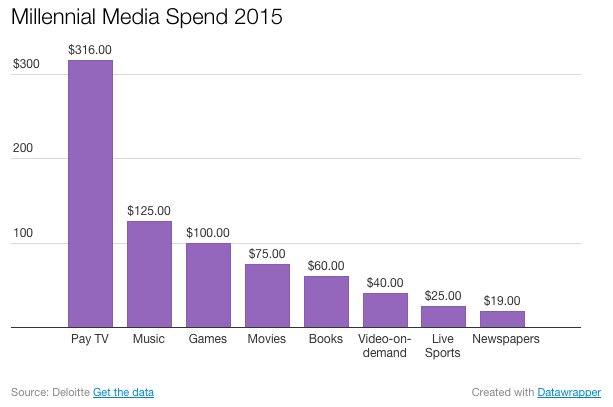
But of the big media formats, newspaper publishers have it the worst: Deloitte projects that the average millennial will pay just $19 on newspapers this year, less than the cost of four Sunday editions of The New York Times. Newspaper companies are also facing a similar money problem on the Web, which is eroding both their advertising revenue and ability to get money directly from readers. And they partially brought that fate upon themselves. “When you have people willing to give their content away for free, charging for it is really hard,” Stewart said.
Deloitte’s projections are just the latest in a long line of attempts to describe and quantify the spending habits of young people, whom analysts and surveys suggest are spending money very differently from previous generations. A recent survey from the Boston Consulting Group (PDF), for example, found that millennials are spending less money perceived as non-essential, such as luxury brands and restaurants, and more money on organic food and other natural products. Millennials are also spending less money on products and more money on experiences, according to a June 2014 survey from Harris Interactive.
Duncan said that media companies can learn a lot from these shifts in spending habits. “It’s not that millennials don’t want to pay for things — it’s just that they don’t want to pay for the things that a lot media companies are making.”


More in Media

How a fashion creator turned audience demand into a 500+ client styling business
A creator with a fashion merchandising degree speaks on her quest to diversify revenue fast, from styling to sweat equity investment.

Forbes looks to Google AI pilot for insights as publishers seek value beyond the click
Forbes has joined Google’s paid News AI pilot that gives Google expanded rights to its content to test new ways of providing readers with context about stories before they click through.

The Verge switches up its audience team to prepare for Google Zero
The Verge has restructured its audience development team to prioritize loyal readers over traffic and page views.